If you searched for "Ollama vs LM Studio vs llama.cpp," you're probably trying to figure out which one is fastest. That's the wrong question. On the same hardware and the same model, all three produce nearly identical token speeds — because two of them are wrappers around the third.
Here's the one-line verdict, then the details.
| Tool | One-liner |
|---|---|
| llama.cpp | The C/C++ engine everything else is built on. Pick it for maximum control. |
| Ollama | A CLI-first runner with a clean OpenAI-compatible API. Pick it to build apps. |
| LM Studio | A polished GUI desktop app. Pick it if you don't want to touch a terminal. |
Why this comparison is a bit of a trap
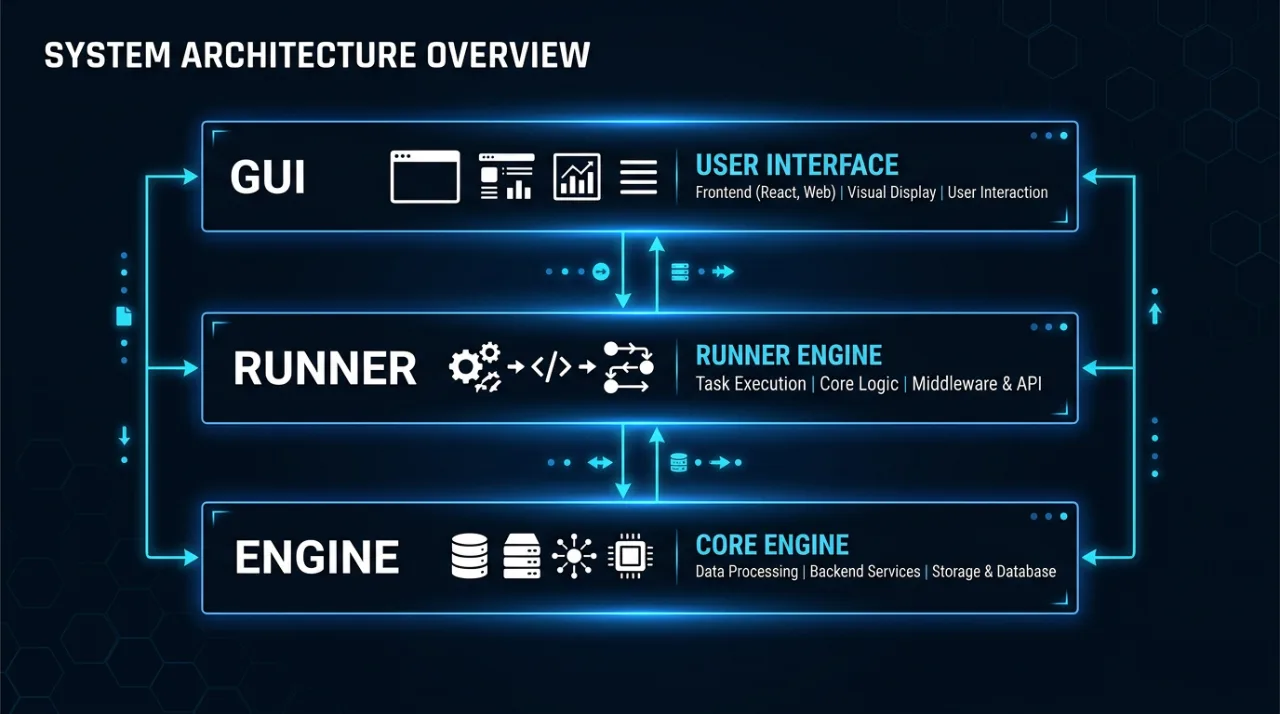
These three aren't rivals competing on a level field. They're three layers of the same stack.
llama.cpp
is the inference engine — the actual C/C++ code that loads a model and generates tokens. Ollama and LM Studio both wrap a llama.cpp-derived engine under the hood. Ollama additionally runs Apple's MLX engine on Apple Silicon (since 0.19) for faster generation.
So when people benchmark "Ollama vs LM Studio" and find them within a few percent of each other, that's not a coincidence — they're running the same math.
The decision that actually matters is about interface, workflow, and how much control you want. Not benchmarks.
llama.cpp — the engine
llama.cpp is an open-source LLM inference engine written in C/C++. It's MIT-licensed, free, and at this point the foundation a huge chunk of the local-LLM world stands on — over 118k GitHub stars as of June 2026. It uses the GGUF model format.
What you get for the steeper learning curve is reach and recency. It supports CPU, CUDA, Metal, Vulkan, and SYCL backends, and new quantization formats tend to land here first (recent work added NVIDIA's NVFP4 format across backends). It runs in places the other two don't bother with — Android and ChromeOS acceleration arrived in late 2025, and multimodal support runs through its libmtmd library.
The catch: you often build it from source, and you drive it with llama-cli or llama-server on the command line. There's no model browser, no one-click anything. If you want to embed inference directly in your own software or run on unusual hardware, this is the layer you want to be at.
Ollama — the CLI runner
Ollama is what most developers reach for first. You install it, run ollama run llama3, and it pulls the model and drops you into a chat. Behind that simplicity is the part that matters for building: an OpenAI-compatible HTTP API, tool calling, and structured outputs via JSON schema. Point your existing OpenAI client at localhost:11434 and most code just works.
It wraps a llama.cpp-derived engine, and on Apple Silicon it uses MLX for faster generation. The current release is the v0.30.x line — v0.30.10 (June 17, 2026) added Command A and North models on Apple Silicon via MLX.
The local runtime is free and unlimited on your own hardware. There's an optional Ollama Cloud if you outgrow your machine:
| Ollama Cloud tier | Price |
|---|---|
| Free | $0 |
| Pro | $20/mo (or $200/yr) |
| Max | $100/mo |
Memory footprint is low — roughly ~100 MB for the runner, since there's no GUI process to feed.
LM Studio — the GUI
LM Studio is the one you hand to someone who doesn't live in a terminal. It's a desktop app with a visual model browser, one-click downloads, a built-in chat UI, and document RAG. It also exposes an OpenAI-compatible local server, so it's not just for clicking around — you can build against it too, with Python and JavaScript SDKs.
It's optimized for Apple Silicon (MLX) and supports NVIDIA GPUs.
The big change: since July 8, 2025, LM Studio is free for both personal and commercial use at work. The old "contact us for a commercial license" requirement is gone — no form, no email. For organizations that need SSO, model/MCP gating, and private collaboration, there are self-serve Teams and Enterprise plans, but their pricing isn't published. (Third-party trackers guess ~$10–25/user/month; treat that as unconfirmed.)
The trade-off is overhead. The GUI process runs around ~500 MB of memory versus Ollama's ~100 MB — usually irrelevant on a 16 GB+ machine, occasionally not on a small one.
The full comparison
| llama.cpp | Ollama | LM Studio | |
|---|---|---|---|
| What it is | C/C++ inference engine (the foundation) | CLI-first model runner (wraps the engine) | GUI desktop app (wraps the engine) |
| Interface | Command line / library | Command line + HTTP API | Graphical app + local server |
| Best for | Max control & embedding | Building apps in the terminal | Visual browsing, no terminal |
| Setup effort | High (often build from source) | Low (ollama run) |
Lowest (download & click) |
| Model format | GGUF | GGUF (own registry) | GGUF + MLX |
| OpenAI-compatible API | Yes (llama-server) |
Yes | Yes |
| Apple Silicon MLX | Metal backend | Yes (0.19+) | Yes |
| Price (local use) | Free (MIT) | Free & unlimited | Free (incl. commercial since Jul 2025) |
| Paid tier | None | Cloud: Pro $20/mo, Max $100/mo | Teams / Enterprise (price not public) |
| Memory overhead | Lowest | Low (~100 MB) | Higher (~500 MB GUI) |
Performance, the honest version
Since LM Studio and Ollama run the same underlying engine, raw generation speed is nearly identical on the same hardware and model. For a Q4_K_M 7B model on an M2 MacBook Pro, you're roughly in the 30–50 tok/s ballpark on a single request — though the exact number is hardware-dependent.
Where it does diverge is the MLX path on Apple Silicon, which can be dramatically faster for larger mixture-of-experts models — one benchmark of Qwen3-Coder-30B-A3B on an M4 Pro Mac mini saw ~130 tok/s on MLX versus ~43 tok/s on the legacy llama.cpp backend. If you're on a Mac running big MoE models, the engine choice matters more than the wrapper.
One caveat worth stating plainly: none of these three is built for serving many concurrent users. For production throughput, vLLM leaves them behind (~793 tok/s vs Ollama's ~41 tok/s under concurrency, with far lower tail latency). If that's your goal, stop reading comparison posts about these three and go look at vLLM.
Which should you pick?
Pick LM Studio if you want the easiest possible start, a GUI, and to browse and try models visually. Now that it's free for work, it's the default for most non-CLI users and small teams just evaluating what runs on their hardware.
Pick Ollama if you're a developer who wants a scriptable CLI and a clean local OpenAI-compatible endpoint to build against, with the lightest footprint. It's the best "I want local LLMs in my code" choice, with Cloud as an escape hatch when local hardware isn't enough.
Pick llama.cpp if you want maximum control, the newest quantization formats and backends first, to embed inference in your own software, or to run on constrained or unusual hardware. Accept that you'll spend more time on setup.
Many people end up using two of them — LM Studio or Ollama for day-to-day, llama.cpp directly when they need something the wrappers haven't exposed yet.
FAQ
Are Ollama and LM Studio just llama.cpp under the hood?
Largely, yes. Both wrap a llama.cpp-derived inference engine, which is why their token speeds are so close on identical hardware. Ollama also uses Apple's MLX engine on Apple Silicon for faster generation on Macs. The differences you actually feel are in the interface and workflow, not the core inference.
Is Ollama or LM Studio faster?
On the same model and hardware, they're within a few percent of each other because they share an engine. The meaningful speed gap is the MLX path on Apple Silicon for large MoE models, where MLX can be roughly 2–3x faster than the legacy llama.cpp backend. For ordinary 7B models on a single request, you won't notice a difference between the two tools.
Can I use these for free commercially?
Yes for all three. llama.cpp is MIT-licensed. Ollama's local runtime is free and unlimited. LM Studio became free for commercial/work use on July 8, 2025, removing its old commercial-license requirement. Paid tiers exist only for hosted Cloud usage (Ollama) or org features like SSO (LM Studio Enterprise).
Which one should a developer building an app choose?
Ollama, in most cases. Its OpenAI-compatible API, tool calling, and JSON-schema structured outputs make it straightforward to point existing client code at a local model, and its memory footprint is small. Reach for llama.cpp directly only if you need a backend, quantization format, or hardware target that Ollama hasn't surfaced yet.
References
- llama.cpp on GitHub and Wikipedia: llama.cpp
- Ollama releases and Ollama pricing
- LM Studio: free for work and LM Studio Enterprise
- Performance figures: codersera 2026 comparison, codersera production benchmark, and popularai speed test