The headline input price on a model's pricing page is insufficient on its own for predicting your bill. Output tokens cost several times more than input, cached input runs at roughly a tenth of base, an asynchronous batch job is half price, and a long prompt can push you into a higher rate tier mid-request.
Get those wrong and a "cheap" model bills more than a "premium" one. This compares the four camps — OpenAI, Anthropic, Google, and hosted open-weight models — by the levers that decide the invoice, then puts today's prices behind them as a dated snapshot.
TL;DR
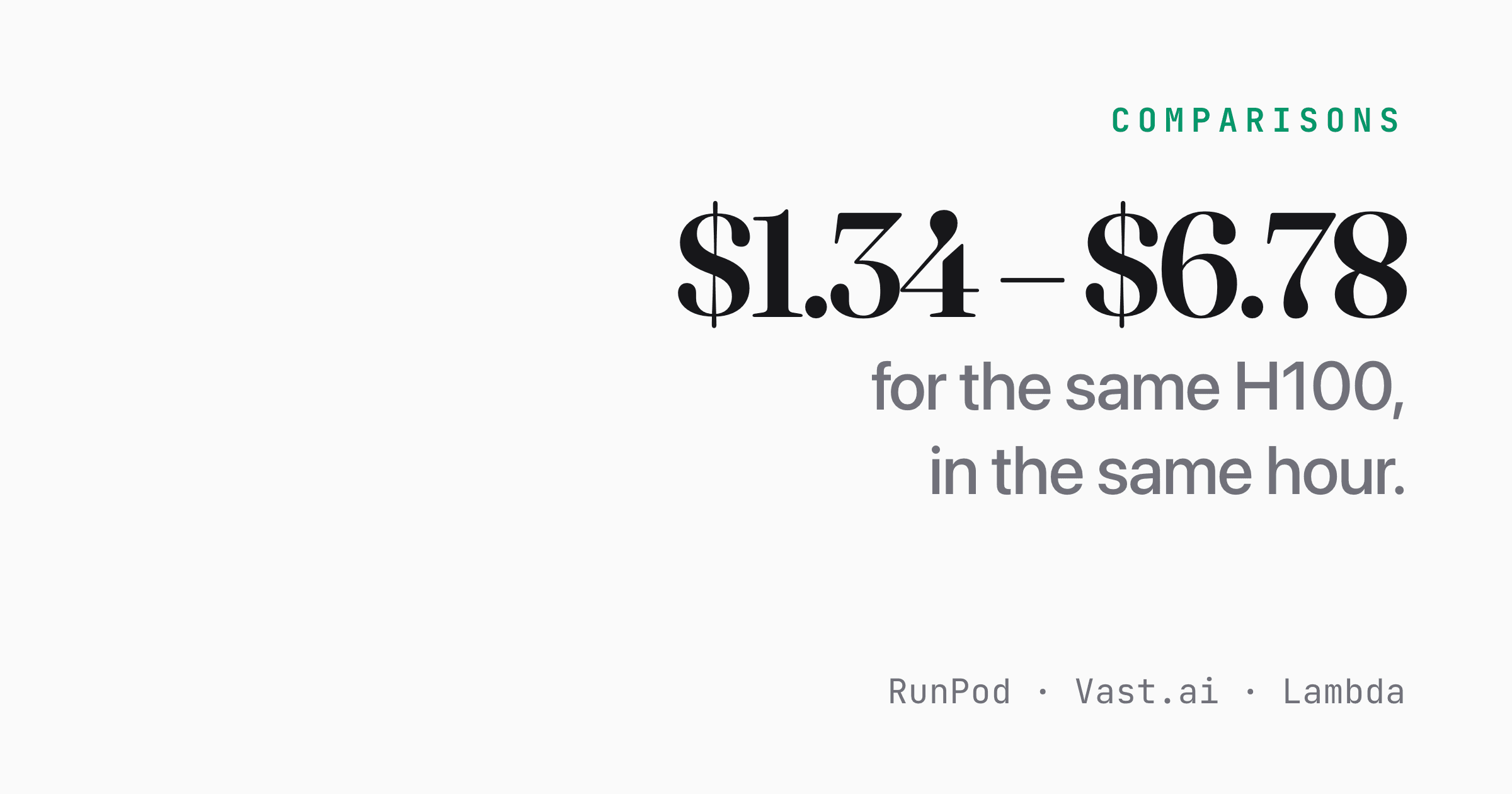
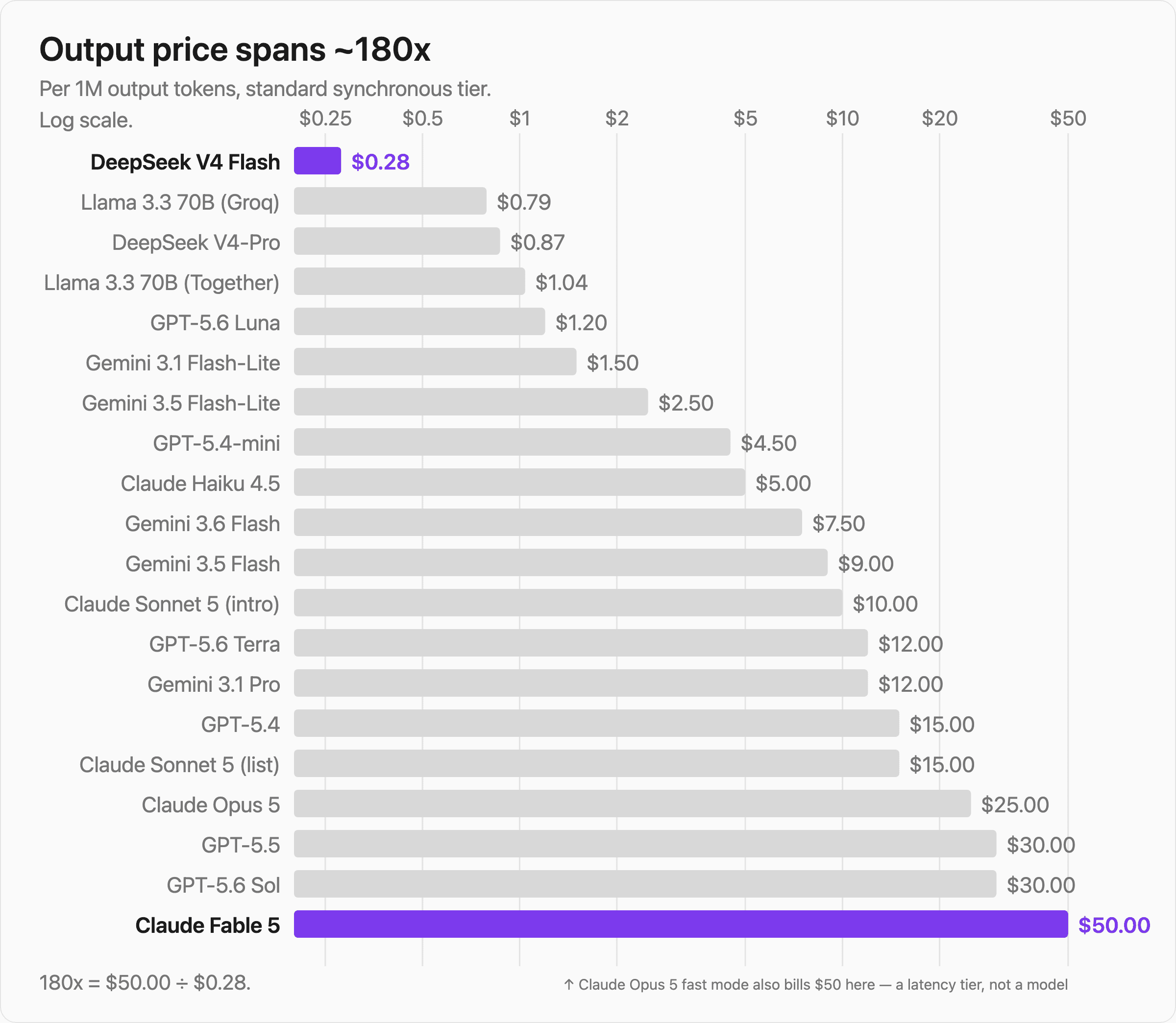
- The output rate decides your ranking. Across the snapshot below, output prices span $0.28 to $50.00 per 1M tokens — roughly 180x — while input prices stay far more bunched.
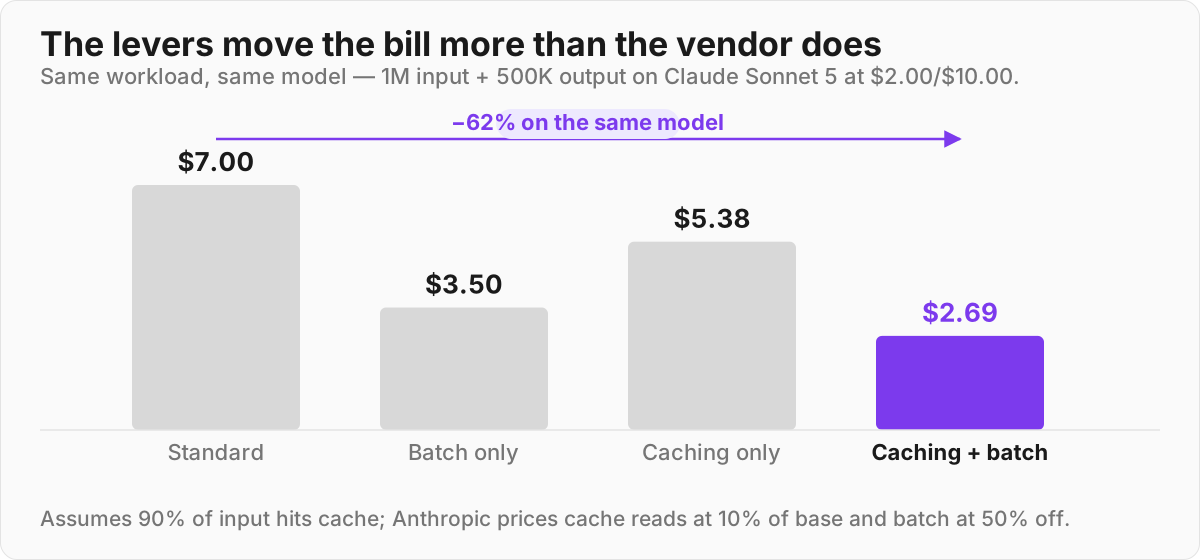
- The levers beat the vendor switch. On one Claude Sonnet 5 workload, caching plus batch takes the same job from $7.00 to $2.69 — about 62% off, without changing model or provider.
- Rock-bottom $/token, you run the ops: DeepSeek V4 Flash ($0.14/$0.28).
- Cheapest managed floor — on short prompts: GPT-5.6 Luna ($0.20/$1.20) undercuts Gemini 3.1 Flash-Lite ($0.25/$1.50). Above OpenAI's length threshold Luna doubles to $0.40/$1.80 and Flash-Lite takes the floor back.
- Frontier-class value: GPT-5.6 Terra ($2.00/$12.00) matches Gemini 3.1 Pro's unit price — and keeps matching it on long prompts, where both step to $4.00/$18.00.
- Production default: Claude Sonnet 5 — $2.00/$10.00 through August 31, $3.00/$15.00 from September 1.
- Best coding/agentic: Claude Opus 5 ($5.00/$25.00); Claude Fable 5 ($10.00/$50.00) above it when budget isn't the constraint.
- The rate only matters while you can call it. Fable 5 was unavailable from June 12 to June 30, 2026 and was restored on July 1 — budget for a fallback, not just for a price.
Output tokens decide the bill
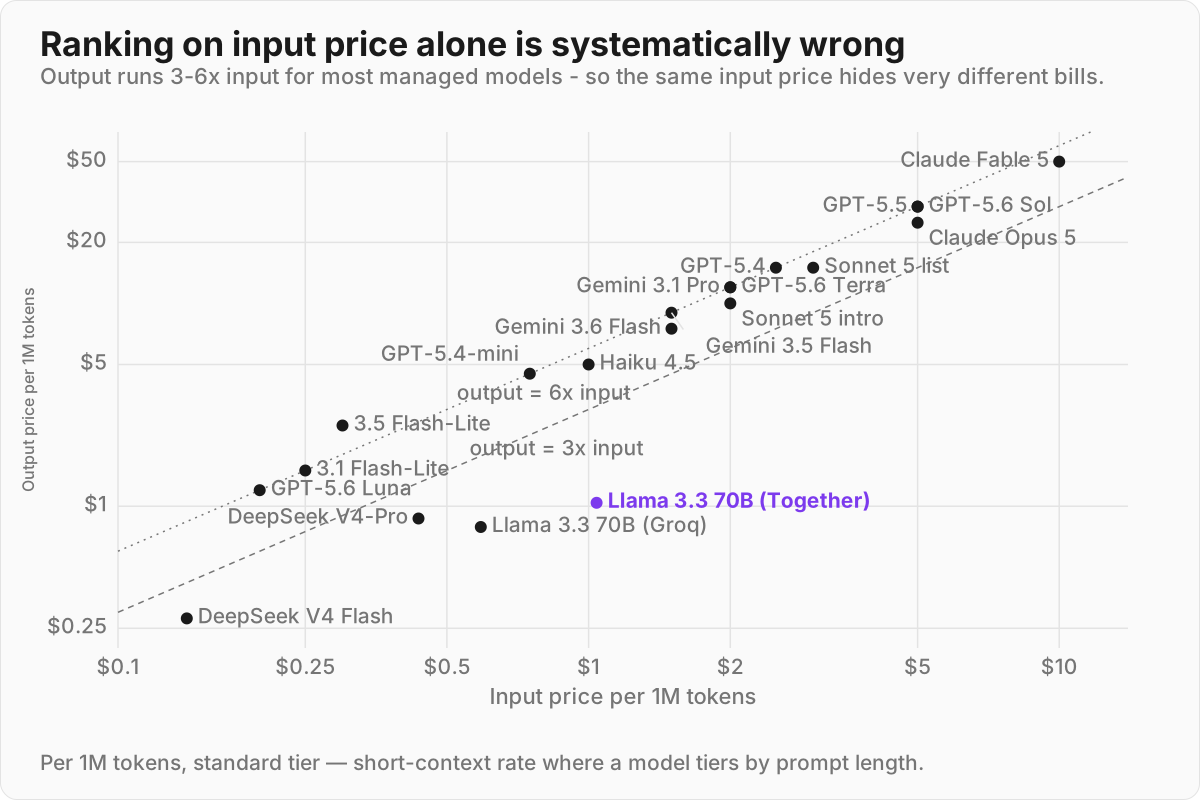
Rank models by input price and you will be systematically wrong. Every provider in this comparison charges more for output than input, and most real workloads are priced by what the model emits, not what you feed it — a support answer, a code diff, a summary, an agent's chain of tool calls.
The gap is not decorative. Across the managed models in today's snapshot, output sits at three to six times input: GPT-5.4 is $2.50 in and $15.00 out, Claude Opus 5 is $5.00 and $25.00, Gemini 3.6 Flash is $1.50 and $7.50, GPT-5.6 Luna is $0.20 and $1.20.
The open-weight camp breaks that band — DeepSeek V4 Flash is only 2x at $0.14/$0.28, and Together prices Llama 3.3 70B flat at $1.04 in both directions — and that inconsistency is exactly why input-only ranking misleads.
The practical consequence: a terse model with a higher sticker price often bills less than a verbose cheaper one, and any estimate you build should weight output far above input.
The five levers
These move your invoice more than the choice of vendor does. Work through them before you run a migration.
Caching is the big one — but reads and writes are priced differently.
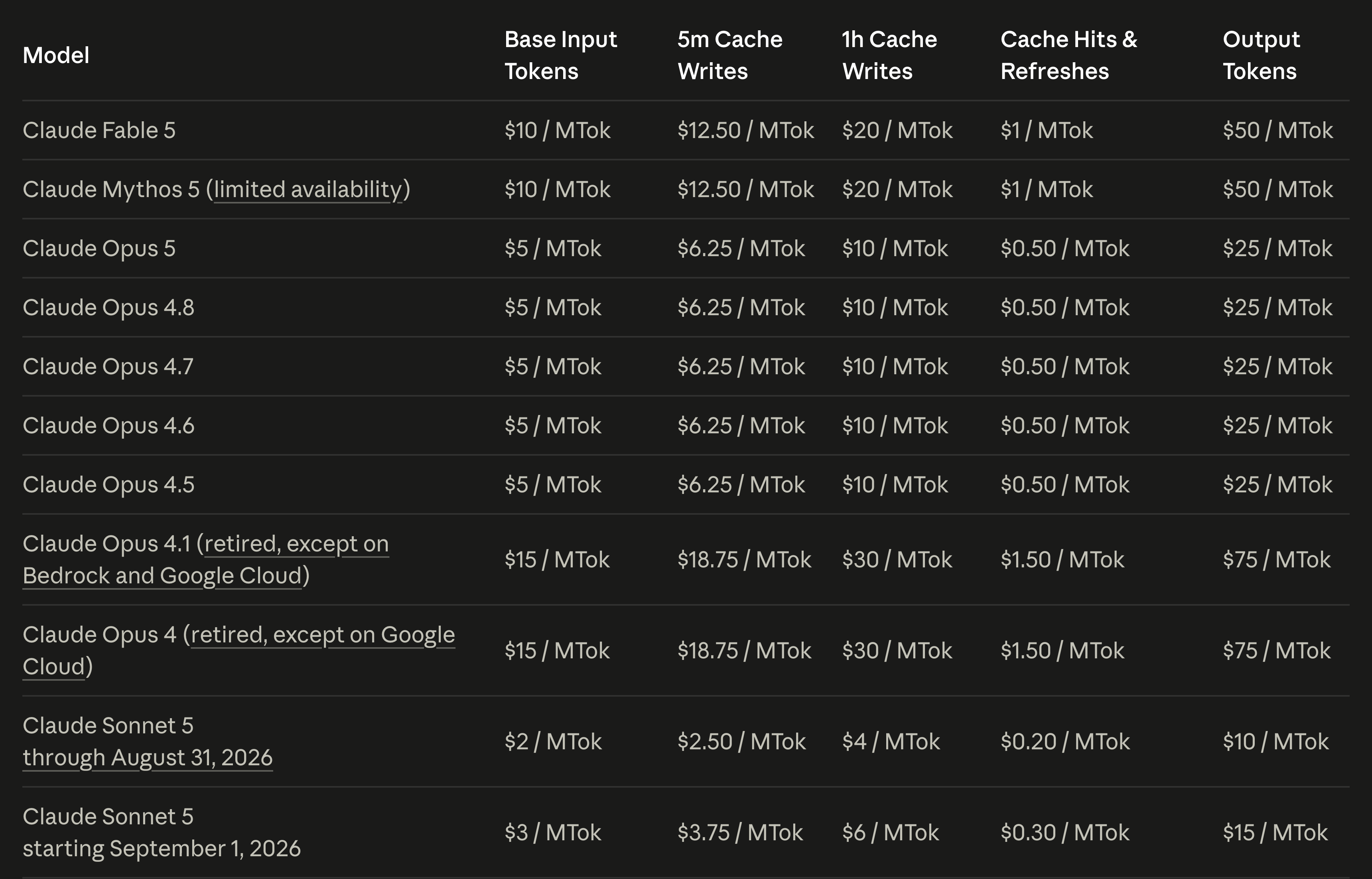
OpenAI and Anthropic both price cached reads at about 10% of base: GPT-5.6 Sol reads cache at $0.50 against $5.00 input, Terra at $0.20 against $2.00, Luna at $0.02 against $0.20, and Claude Opus 5 at $0.50 against $5.00. DeepSeek is more aggressive still — a cache hit bills at 2% of the base rate.
Writes carry a premium in the other direction: Anthropic charges 1.25x base to write a 5-minute-TTL cache entry and 2x base for a 1-hour TTL.
So caching pays when a stable prefix is read many times per write, and can cost you money when it isn't — a rarely-reused 1-hour entry bills 2x on the way in to save 0.1x on a read that may never come.
For an agent or RAG app that re-sends a large stable system prompt on every turn, cache reads dominate the input side of the bill, and enabling them cuts that side by roughly 90%.
Batch is a flat 50% off, at all three big labs.
Anthropic lists Claude Opus 5 batch at $2.50/$12.50 against $5.00/$25.00 standard. Google lists Gemini 3.6 Flash batch at $0.75/$3.75 against $1.50/$7.50, and Gemini 3.5 Flash-Lite at $0.15/$1.25 against $0.30/$2.50. OpenAI applies the same halving. Exactly half, input and output. Anything that isn't interactive — evals, enrichment, backlog summarization, nightly classification — should be running through it.
Long context can change the rate.
Two of the three big labs tier by prompt length. Gemini 3.1 Pro charges $4/$18 above 200K (vs $2/$12 below). OpenAI tiers its entire current lineup, new line included: GPT-5.6 Sol goes $5/$30 → $10/$45, Terra $2/$12 → $4/$18, and Luna $0.20/$1.20 → $0.40/$1.80; on the older line GPT-5.5 goes $5/$30 → $10/$45 and GPT-5.4 $2.50/$15 → $5/$22.50, both at a 272K threshold.
Anthropic is the exception — Claude 4.6 and later bill their full 1M-token window at flat standard rates, so a 900K-token request costs the same per token as a 9K one. That flat window is the one structural pricing advantage Anthropic has here, and it only shows up on long prompts.
Service tiers cut both ways.
Batch is the discount direction; latency is the premium direction, and it is easy to switch on by accident. Anthropic's fast mode on Opus 5 and Opus 4.8 bills $10/$50 — exactly 2x standard, and a coincidental match for Claude Fable 5's list price, which is a different model rather than a tier. Google's Priority tier runs 1.8x standard, putting Gemini 3.5 Flash at $2.70/$16.20.
Google's Flex tier goes the other way and is priced identically to batch — $0.75/$4.50 on 3.5 Flash — without the 24-hour turnaround, which makes it the most underused lever on this list.
Prompt design changes the token count itself.
The same text is not the same number of tokens across vendors, so any like-for-like price comparison carries a tokens-per-task caveat. Anthropic's own documentation notes that its newer tokenizer, used from Claude 4.7 onward, produces approximately 30% more tokens for the same text than the tokenizer in earlier models — enough to erase a small per-token edge on its own.
On the output side, the length you allow the model to produce is the single variable you control directly, and it multiplies against the most expensive rate on the page.
Stack the first two levers and the effect is larger than most vendor migrations deliver, with none of the re-evaluation work.
Today's price snapshot
This is the part that ages. Treat it as a dated example of the reasoning above, not as the reasoning itself.
| Camp | Model | Input $/1M | Output $/1M | Context | Best fit |
|---|---|---|---|---|---|
| OpenAI | GPT-5.6 Sol | $5.00+ | $30.00+ | 1.05M (tiered) | Frontier reasoning |
| OpenAI | GPT-5.6 Terra | $2.00+ | $12.00+ | 1.05M (tiered) | Frontier-class value pick |
| OpenAI | GPT-5.6 Luna | $0.20+ | $1.20+ | 1.05M (tiered) | Cheapest managed model here |
| OpenAI | GPT-5.5 | $5.00+ | $30.00+ | 272K (tiered) | Deepest tooling ecosystem |
| OpenAI | GPT-5.4 | $2.50+ | $15.00+ | 272K (tiered) | Balanced general workhorse |
| OpenAI | GPT-5.4-mini | $0.75+ | $4.50+ | 272K (tiered) | Cheap high-volume tasks |
| Anthropic | Claude Fable 5 | $10.00 | $50.00 | 1M | Premium flagship, cost no object |
| Anthropic | Claude Opus 5 | $5.00 | $25.00 | 1M | Best-in-class coding/agentic |
| Anthropic | Claude Opus 4.8 | $5.00 | $25.00 | 1M | Previous generation, same price |
| Anthropic | Claude Sonnet 5 (now–Aug 31) | $2.00 | $10.00 | 1M | Production default, intro pricing |
| Anthropic | Claude Sonnet 5 (from Sep 1) | $3.00 | $15.00 | 1M | Standard list price |
| Anthropic | Claude Haiku 4.5 | $1.00 | $5.00 | 200K | Fast, cheap, good-enough |
| Anthropic | Opus 5 / 4.8, fast mode | $10.00 | $50.00 | 1M | Not a model — a latency tier, 2x standard |
| Gemini 3.1 Pro (Preview) | $2.00+ | $12.00+ | Tiers at 200K | Frontier-class multimodal | |
| Gemini 3.6 Flash | $1.50 | $7.50 | — | Volume multimodal, current pick | |
| Gemini 3.5 Flash | $1.50 | $9.00 | — | Prior Flash generation | |
| Gemini 3.5 Flash-Lite | $0.30 | $2.50 | — | Cheap Gemini with a free tier | |
| Gemini 3.1 Flash-Lite | $0.25 | $1.50 | — | Prior ultra-cheap tier | |
| Open | DeepSeek V4-Pro | $0.435 | $0.87 | 1M | Long context at open-model prices |
| Open | DeepSeek V4 Flash | $0.14 | $0.28 | — | Rock-bottom $/token |
| Open | Llama 3.3 70B (hosted) | $0.59–$1.04 | $0.79–$1.04 | — | Host-dependent, self-host option |
*Snapshot: 2026-08-09. A + marks a rate that increases above a length threshold — see the long-context lever above. A — in Context means the window was not re-verified on this date; check the provider's page. Llama 3.3 70B spans Groq at $0.59/$0.79 to Together at $1.04 flat.
Two lines read $10/$50 and they are not the same thing: Claude Fable 5 is a distinct model with its own weights, while the italicized last row is the fast-mode service tier applied to Opus 5 or 4.8 — same price, different product.*
Read the output column first. That spread — $0.28 to $50.00 — is what separates these models in production.
Camp by camp
OpenAI now runs two generations side by side, and the newer one is cheaper on short prompts and far larger on context. GPT-5.6 went GA on July 9, with Terra cut 20% and Luna cut 80% on July 30. Terra at $2.00/$12.00 matches Gemini 3.1 Pro's unit price on a 1.05M window; Luna at $0.20/$1.20 is the cheapest managed model in this table.
The older 5.5/5.4 line still carries the deepest third-party integration surface, and 5.4 is exactly half of 5.5 on the flagship pair — though that ratio doesn't extend to the pro variants, which are priced identically at $30/$180.
What does not change between the generations is the shape of the bill: every OpenAI line here charges a higher rate above a prompt-length threshold, so a long-context workload is not priced off the headline number.
Anthropic wins on coding and long-horizon agentic work, and it is the only camp here with no long-context surcharge at all. Opus 5 shipped on July 24 at $5.00/$25.00 — the same list price as Opus 4.8, which makes the upgrade a straight swap rather than a budget decision.
Sonnet 5 is the production default at $2.00/$10.00 through August 31, moving to $3.00/$15.00 on September 1; if you are sizing a budget past the summer, size it at the list price. Caching is the strongest lever in this camp, with reads at about 10% of base and writes at 1.25x or 2x depending on TTL.
Claude Fable 5 sits above the Opus line at $10.00/$50.00 with the same 1M window, and it is the pick when budget genuinely isn't the constraint. Two things to watch: the Claude 4.7-and-later tokenizer emits roughly 30% more tokens for the same text than earlier models, and fast mode silently doubles an Opus rate to $10/$50.
Google is in an awkward spot at the top of its own lineup. Gemini 3.1 Pro is still a preview model — the ID is gemini-3.1-pro-preview — and it tiers from $2/$12 to $4/$18 above 200K, which means its headline price only holds on short prompts.
Every Flash-tier Gemini has a free tier, which still makes this the easiest camp to prototype on for nothing, but note that Gemini 3.1 Pro, the frontier-class model, is Preview and has no free tier.
Below the top, the picture is cleaner: 3.6 Flash matches 3.5 Flash's $1.50 input while cutting output from $9.00 to $7.50, so there is no reason left to start a new project on 3.5 Flash.
Open / open-weight (hosted) still owns the floor on $/token, at the cost of doing your own ops and evaluation. DeepSeek V4 Flash runs $0.14/$0.28, V4-Pro adds a 1M-token window at $0.435/$0.87, and DeepSeek's 2% cache-hit rate is the most aggressive caching discount in this comparison by a wide margin — worth more than the sticker gap for context-heavy apps.
Llama 3.3 70B has no canonical price: it is $0.59/$0.79 on Groq and $1.04 flat in both directions on Together. Treat any single figure as representative of one host, not of the weights.
The line item that isn't on any pricing page
A model's rate only matters while you can call it. Claude Fable 5 was unavailable from June 12 to June 30, 2026, under export-control restrictions, and came back on July 1 — Anthropic's announcement states that "Access to Claude Fable 5 and Mythos 5 is now restored".
It was redeployed with an additional cybersecurity classifier; on that classifier Anthropic writes, "The new classifier means that the specific technique described in the Amazon report is blocked in over 99% of cases."
Nineteen days is not a rounding error for anything in production. The cost of that outage doesn't appear in any $/1M figure, and it lands entirely on teams that wired a single flagship in as a hard dependency.
The design conclusion is the same as the pricing one: keep the model behind an interface you can repoint. A fallback wired to a cheaper model in the same family costs nothing while it is idle, and it is the only lever on this page that pays off on a day when the rate card is irrelevant.
Price your primary model, but budget for the day you have to run on your second choice.
Worked example: a support-bot turn
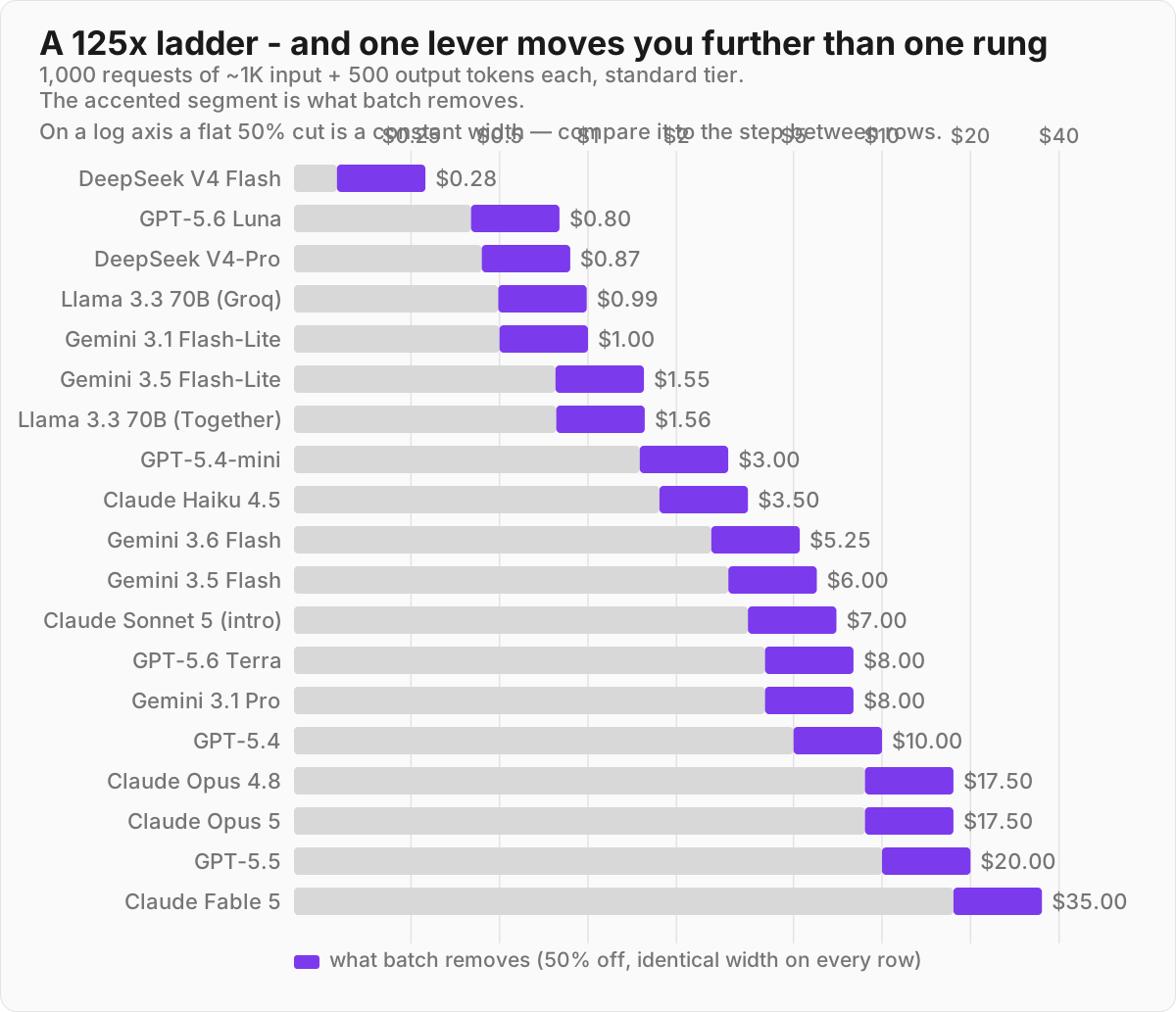
Assume each request is ~1K input + 500 output tokens, and price per 1,000 requests (so 1M input + 500K output tokens total). No caching, no batch — the raw standard-tier cost.
| Model | Cost / 1,000 requests |
|---|---|
| DeepSeek V4 Flash | $0.28 |
| GPT-5.6 Luna | $0.80 |
| DeepSeek V4-Pro | $0.87 |
| Llama 3.3 70B (Groq) | ~$0.99 |
| Gemini 3.1 Flash-Lite | $1.00 |
| Gemini 3.5 Flash-Lite | $1.55 |
| Llama 3.3 70B (Together) | $1.56 |
| GPT-5.4-mini | $3.00 |
| Claude Haiku 4.5 | $3.50 |
| Gemini 3.6 Flash | $5.25 |
| Gemini 3.5 Flash | $6.00 |
| Claude Sonnet 5 (intro) | $7.00 |
| GPT-5.6 Terra | $8.00 |
| Gemini 3.1 Pro | $8.00 |
| GPT-5.4 | $10.00 |
| Claude Opus 5 | $17.50 |
| Claude Opus 4.8 | $17.50 |
| GPT-5.5 | $20.00 |
| Claude Fable 5 | $35.00 |
Snapshot: 2026-08-09. Standard synchronous tier, no caching, no batch. Claude Sonnet 5 is shown at the intro rate; at the September list price the same job is $10.50.
That is a 125x spread for the same task shape, from DeepSeek's $0.28 to Fable 5's $35.00 — and still about 44x if you stay inside managed models, from Luna's $0.80 to that same $35.00. Now apply the levers. Batch halves every row in that table exactly. A stable cached system prompt cuts the input portion by roughly 90%, or 98% on DeepSeek.
For a RAG bot re-sending 20K tokens of context every turn, caching is the difference between a sustainable bill and a runaway one — and it usually saves more than dropping one rung down this ladder.
Which should you pick for whom
- Cheapest possible, high volume, you'll handle ops: DeepSeek V4 Flash, or hosted Llama 3.3 70B if you want a permissive-weights option you can move in-house.
- Cheapest managed, no ops: GPT-5.6 Luna at $0.20/$1.20, below the Gemini Flash-Lite tiers — as long as your prompts stay under the length threshold.
- Frontier-class on a budget: GPT-5.6 Terra — same $2/$12 as Gemini 3.1 Pro on short prompts and the same $4/$18 above the threshold, but on a 1.05M window instead of Gemini's, and not a preview model.
- Balanced production app: Claude Sonnet 5 while the intro price holds, or GPT-5.4 if you need OpenAI's tooling surface.
- Coding/agentic, cost secondary: Claude Opus 5, paired with caching and batch to blunt the $25 output rate. Leave fast mode off unless latency is worth 2x.
- Top of the range, budget not the constraint: Claude Fable 5 at $10/$50 — with a fallback wired in, given June's 19-day interruption.
Prices moved several times in H1 2026 and moved twice in July alone. Before you commit, open each provider's own pricing page and re-check the three numbers that decide your bill: the output rate, the cache-read rate, and where the length tier starts.
FAQ
Which LLM API is cheapest in 2026?
For raw $/token, hosted open models still win — DeepSeek V4 Flash at $0.14/$0.28 per 1M. Among managed models, GPT-5.6 Luna at $0.20/$1.20 is the floor for short prompts — it tiers up to $0.40/$1.80 on long ones, where the untiered Gemini 3.1 Flash-Lite ($0.25/$1.50) is cheaper and Gemini 3.5 Flash-Lite ($0.30/$2.50). The catch with open models is that you own more of the ops and evaluation work.
Is GPT cheaper than Claude?
It depends on the date. Through August 31, Claude Sonnet 5's intro pricing ($2/$10) undercuts GPT-5.4 ($2.50/$15) on both sides; from September 1 it lists at $3/$15 and GPT-5.4 is cheaper on input. At the top, GPT-5.5 ($5/$30) costs more on output than Claude Opus 5 ($5/$25), and Claude bills its full 1M window flat while GPT-5.5 doubles above 272K.
Are open-source LLMs cheaper than GPT or Claude?
On per-token price, almost always yes — often by 10x or more. But "cheaper" assumes you absorb hosting, scaling, and quality-evaluation costs that a managed API includes. For low-to-medium volume, a managed model is frequently cheaper all-in once engineering time is counted — and the managed floor has dropped, with GPT-5.6 Luna at $1.20 output now within striking distance of hosted Llama at $0.79–$1.04.
What's the single fastest way to cut my LLM bill?
Cache your stable context and batch anything non-interactive. Together those two took the Sonnet 5 example above from $7.00 to $2.69 per 1,000 requests. Neither requires changing model or vendor, and both take less work than a migration.
References
- OpenAI API pricing — https://openai.com/api/pricing/ , https://developers.openai.com/api/docs/pricing
- Anthropic / Claude pricing — https://platform.claude.com/docs/en/about-claude/pricing
- Anthropic, redeploying Claude Fable 5 — https://www.anthropic.com/news/redeploying-fable-5
- Google Gemini API pricing — https://ai.google.dev/gemini-api/docs/pricing
- DeepSeek API pricing — https://api-docs.deepseek.com/quick_start/pricing
- Groq pricing — https://groq.com/pricing
- Together AI pricing — https://www.together.ai/pricing