Renting a GPU by the hour looks like a price-comparison problem, which is exactly why most GPU price comparisons are wrong within a month of publication. The same H100 SXM can cost you $1.34/hr on the cheapest Vast.ai listing and $4.29/hr on a single-GPU Lambda instance — a 3.2x spread for nominally the same silicon.
But the spread isn't the finding. The reason the spread exists is: the three platforms don't sell compute the same way. RunPod posts a flat rate split into two tiers. Vast.ai runs a marketplace, where the price isn't a number but a distribution of listings. Lambda posts a flat rate too, but quotes it per GPU while selling instances in fixed multi-GPU configurations.
Those three shapes are stable. The rates inside them are not.
So this is a buyer's comparison built the durable way round: how each platform prices compute first, today's numbers second, as a snapshot of that structure on one particular day.
TL;DR — pick by who you are
- You're price-driven and your job can tolerate interruptions (batch inference, research on a budget, fault-tolerant training) → Vast.ai. Cheapest if you shop the bottom of the marketplace and can use interruptible instances — not automatically cheaper on on-demand.
- You want the best balance of price, reliability, and developer experience (serverless inference, per-second billing, a stable default) → RunPod.
- You're training large models on multi-GPU clusters and need enterprise reliability → Lambda. Highest per-hour rates, built for scale.
One line: Vast.ai when price rules, RunPod for balance, Lambda for serious training.
The three platforms sell compute three different ways
RunPod — one flat rate, in two tiers
RunPod publishes a fixed hourly price per GPU, then splits it into two tiers. Secure Cloud runs in T3/T4 datacenters; Community Cloud uses vetted community hosts and runs cheaper. Same card, two posted prices, both fixed.
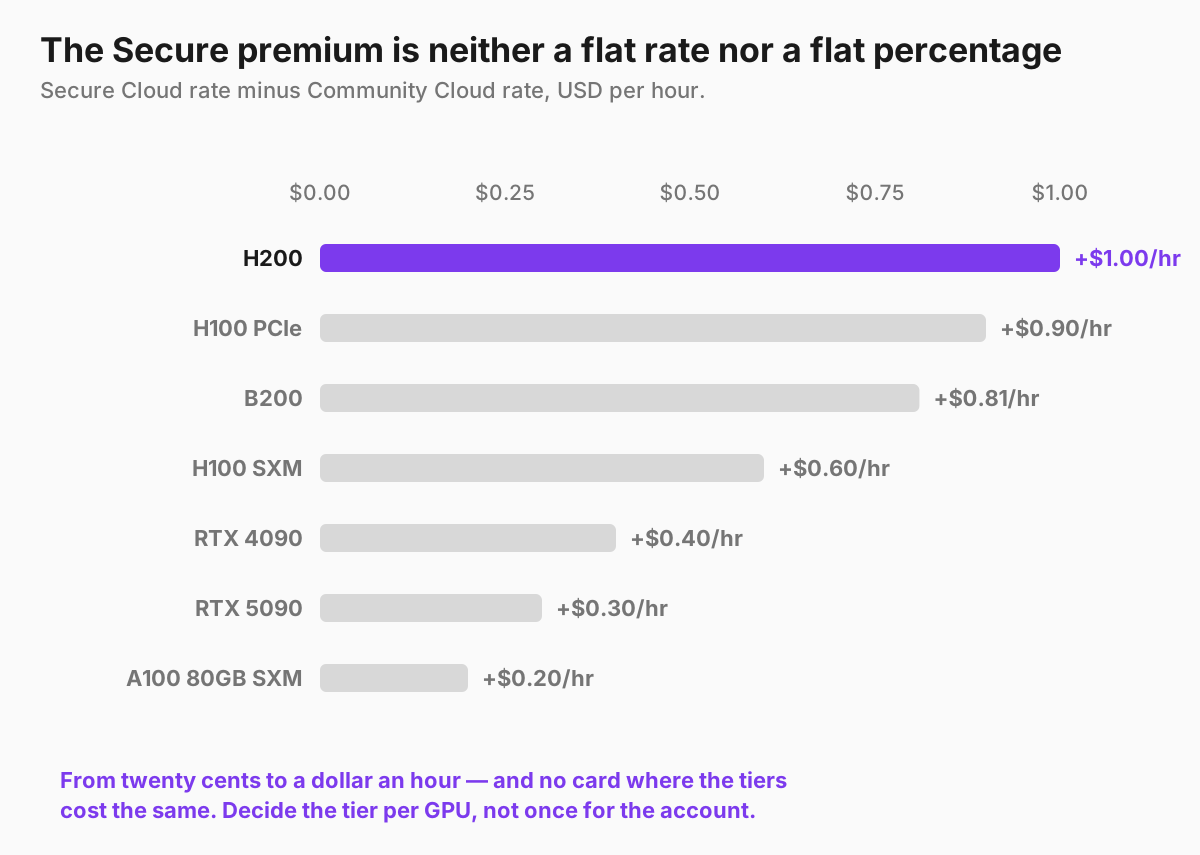
The size of that discount is the part people get wrong, usually by treating it as a flat markup. It isn't one. Community Cloud runs cheaper than Secure — the gap ranges from $0.20/hr (A100 80GB, $1.39 vs $1.59) to $1.00/hr (H200, $3.59 vs $4.59) as of August 2026. Check both tabs on the pricing page; the spread is not uniform.
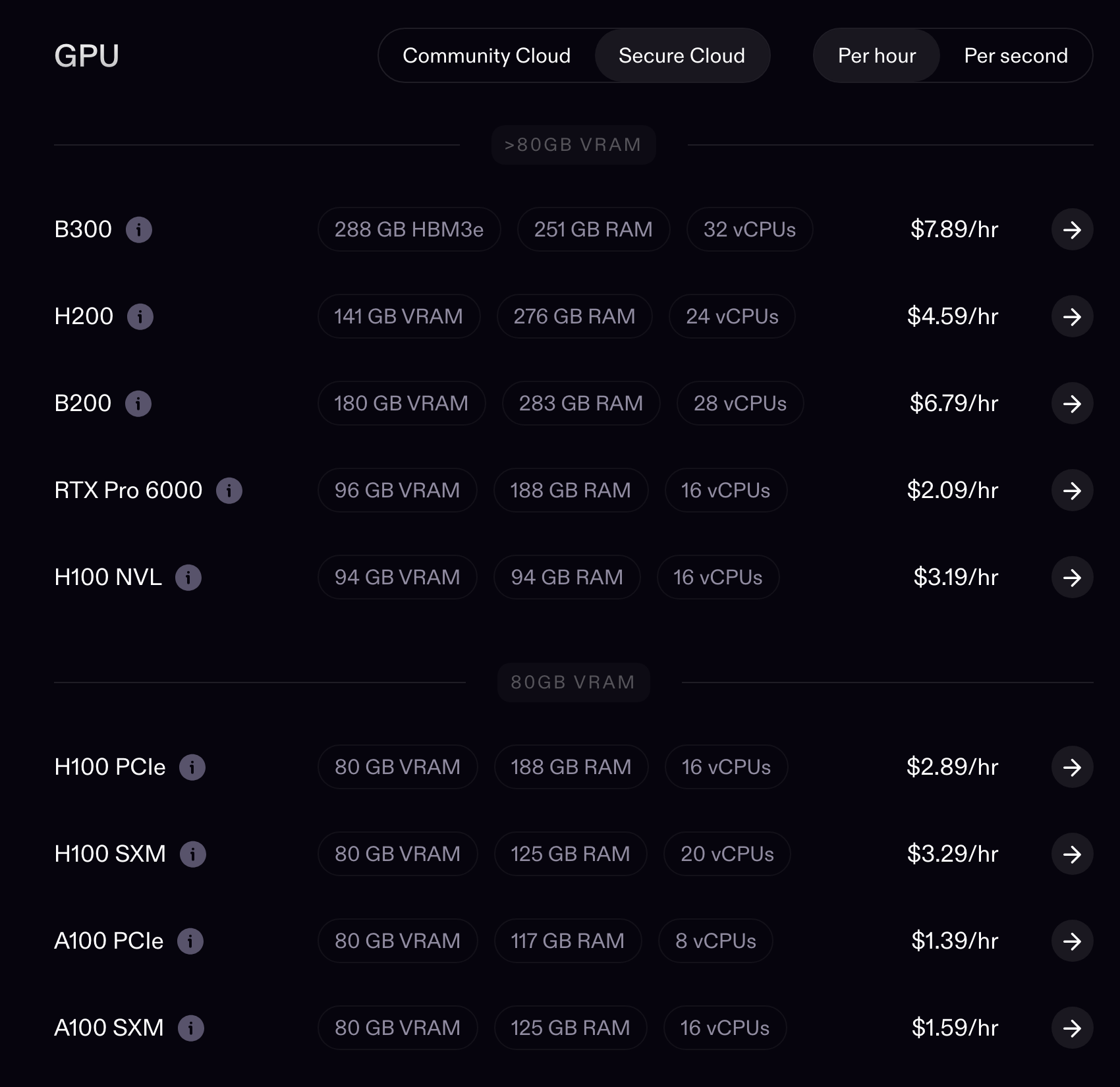
Two structural facts sit behind that cheap Community column, and neither is on the pricing page. First, in RunPod's own words: "Runpod is no longer accepting new hosts for Community Cloud." Supply on the discount tier is capped by whoever is already in it — it will not grow to meet demand the way the Secure tier can.
Second, Community reliability varies by host, so Secure remains the safe default for anything you can't afford to lose.
RunPod's serverless product prices on a third axis again, and the popular description of it is wrong. Serverless bills per second, rounded up, and flex workers scale to zero between requests — though the default 5-second idle timeout is billable, so very short, very frequent calls carry an overhead you should tune. It is not millisecond billing, and idle is not free by default.
Vast.ai — the price is a distribution, not a number
Vast.ai is a marketplace spanning 40+ data centers plus independent hosts. There is no "Vast.ai price" for an H100. There is a book of listings, each with its own hourly rate, host, hardware revision, and reliability score. Quoting a single Vast.ai figure means silently picking a statistic out of that book — and which statistic you pick changes the entire conclusion of the comparison.
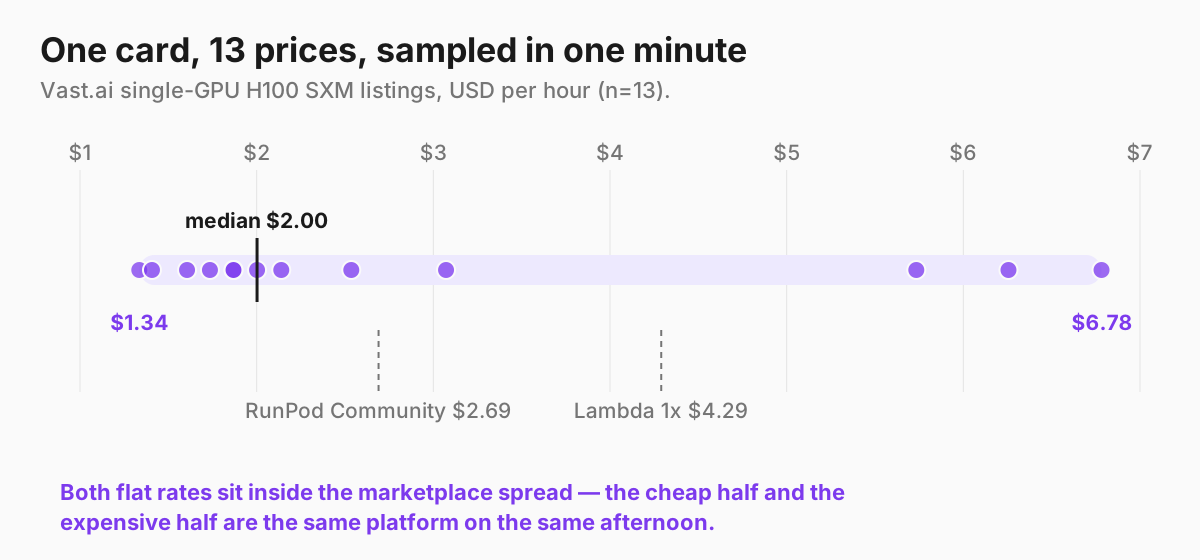
Sampled from Vast.ai's public API on 2026-08-24, on-demand H100 SXM listings ran from $1.34 to $6.78 per hour across 13 listings, with a median of $2.00. Read that against the flat-rate clouds: the cheapest listing undercuts Lambda's single-GPU rate by about 69%, and even the median listing lands under RunPod Community's $2.69.
What the marketplace buys you is not a better price so much as a wider one. The top of this book — $6.78 — is above every flat rate in this article, so the same search that finds a bargain can just as easily find the worst deal available.
Vast.ai also has three rental modes, not the two most comparisons mention:
- On-Demand — Vast.ai's own term for it is "Fixed pricing", with "guaranteed resources (high priority)". Read that phrase precisely: it's a claim about resource priority, not an uptime SLA.
- Interruptible — the cheapest path, preemptible, and advertised as "often 50%+ cheaper".
- Reserved — "Discounted rates with pre-payment", up to a 50% discount, on 1-, 3-, or 6-month terms.
Reserved deserves more billing than it usually gets, because it undercuts the standard advice about this platform. "Avoid Vast.ai if you need predictable costs" assumes the marketplace is all Vast.ai sells. Prepaid reserved capacity is a fixed-price product on the same platform, aimed at exactly that objection.
One mechanism is worth internalizing, because it explains why a rate you saw last week may be unreachable today. On-demand listings are fixed-price — the host sets a number and it doesn't move dynamically. What moves is the floor: cheap listings get rented, and the cheapest thing still available climbs. Bidding is the interruptible market's mechanism, not on-demand's.
"The Vast.ai price went up" almost always means "the cheap one sold."
Lambda — a flat rate, quoted per GPU, sold by the configuration
Lambda is a fixed-price AI cloud, on-demand only. No spot market, no preemption, and the rate you're quoted is the rate you pay. The subtlety is that the per-GPU rate is a function of how many GPUs are in the instance, and the number on the headline is usually the 8-GPU one.
H100 SXM runs $3.99/hr per GPU at 8x, $4.09 at 4x, $4.19 at 2x, and $4.29 at 1x. B200 is $6.69 at 8x and $6.99 at 1x. A100 80GB SXM is $2.79 — in an 8-GPU configuration only, with no single-GPU option, which means "an A100 hour on Lambda" is really eight A100 hours. A100 40GB SXM is $1.99 at 8x.
Elsewhere on the page: H100 PCIe $3.29, GH200 $2.29, and a cheap legacy tier — V100 $0.79, A6000 $1.09, A10 $1.29.
Lambda bills in one-minute increments, and there are "no egress fees" — you are, in Lambda's own words, "not charged for ingress or egress."
The hourly rate is not the price
Three line items sit outside the hourly rate and can outweigh it.
Storage.
RunPod's is fixed and published: Network Volume Standard at $0.07/GB/month under 1TB and $0.05/GB/month above it, High-Performance at $0.14, Container Disk at $0.10, and Volume Disk at $0.10/GB/month while running and $0.20/GB/month while idle. That last pair is the beginner trap — parking a volume between runs costs twice what using it does.
Vast.ai's storage is set by the host, and the spread across hosts is enormous: roughly $0.0003 to $1.00/GB/month, with a median near $0.20. Bandwidth is billed on "both upload and download", at anywhere from $0.0000026 to $0.039/GB depending on the host. And the billing doesn't stop when you do: **"Storage charges continue even when instances are stopped.
Delete instances completely to cease storage billing."** A cheap GPU on an expensive host is not a cheap rental.
Data transfer. Lambda's "no egress fees" is the single most under-reported number in this comparison. On the platform routinely framed as the expensive one, moving a large dataset out costs nothing.
Minimum configuration. If the card you want only exists in an 8-GPU instance — as A100 80GB does on Lambda — the per-GPU rate is not a price you can actually pay. Multiply first.
Today's snapshot: hourly rates
USD per hour, on-demand, normalized to one GPU. RunPod and Lambda are posted flat rates; Vast.ai figures are sampled from its public API and will have moved by the time you read this.
| GPU | RunPod Community | RunPod Secure | Vast.ai on-demand (low – high, median) | Lambda |
|---|---|---|---|---|
| H100 SXM | $2.69 | $3.29 | $1.34 – $6.78, median $2.00 (n=13) | $4.29 (1x) / $3.99 (8x) |
| H100 PCIe | $1.99 | $2.89 | $1.67 – $3.20, median $2.27 (n=5) | $3.29 (configuration not broken out) |
| A100 80GB SXM | $1.39 | $1.59 | $0.60 – $1.64, median $1.08 (n=13)† | $2.79 (8x only) |
| RTX 4090 | $0.34 | $0.74 | $0.13 – $0.40, median $0.34 (n=64\*) | not offered |
| RTX 5090 | $0.69 | $0.99 | $0.32 – $0.60, median $0.42 (n=64\*) | not offered |
| H200 | $3.59 | $4.59 | $3.30 – $4.08, median $4.00 (n=5)‡ | not listed§ |
| B200 | $5.98 | $6.79 | $4.63 – $10.56, median $5.88 (n=5) | $6.99 (1x) / $6.69 (8x) |
* Sample truncated. For RTX 4090 and RTX 5090 the API returned its 64-result cap on an ascending price sort, so those two rows are the 64 cheapest listings rather than the whole book. Their median and maximum are biased low — the real market extends above what's shown. Every other row is the complete set of single-GPU on-demand listings at sample time.
† This row filters for boards carrying 80 GB. Querying "A100" without that filter mixes 40 GB cards in and drags the low end down — an earlier version of this table did exactly that.
‡ Vast.ai lists H200 and H200 NVL as separate parts. This row is the plain H200; the NVL listings sampled cheaper, $2.34 – $3.74 with a median of $3.60 across 7 listings.
§ H200 appears in the heading of Lambda's pricing page but has no row in its rate table.
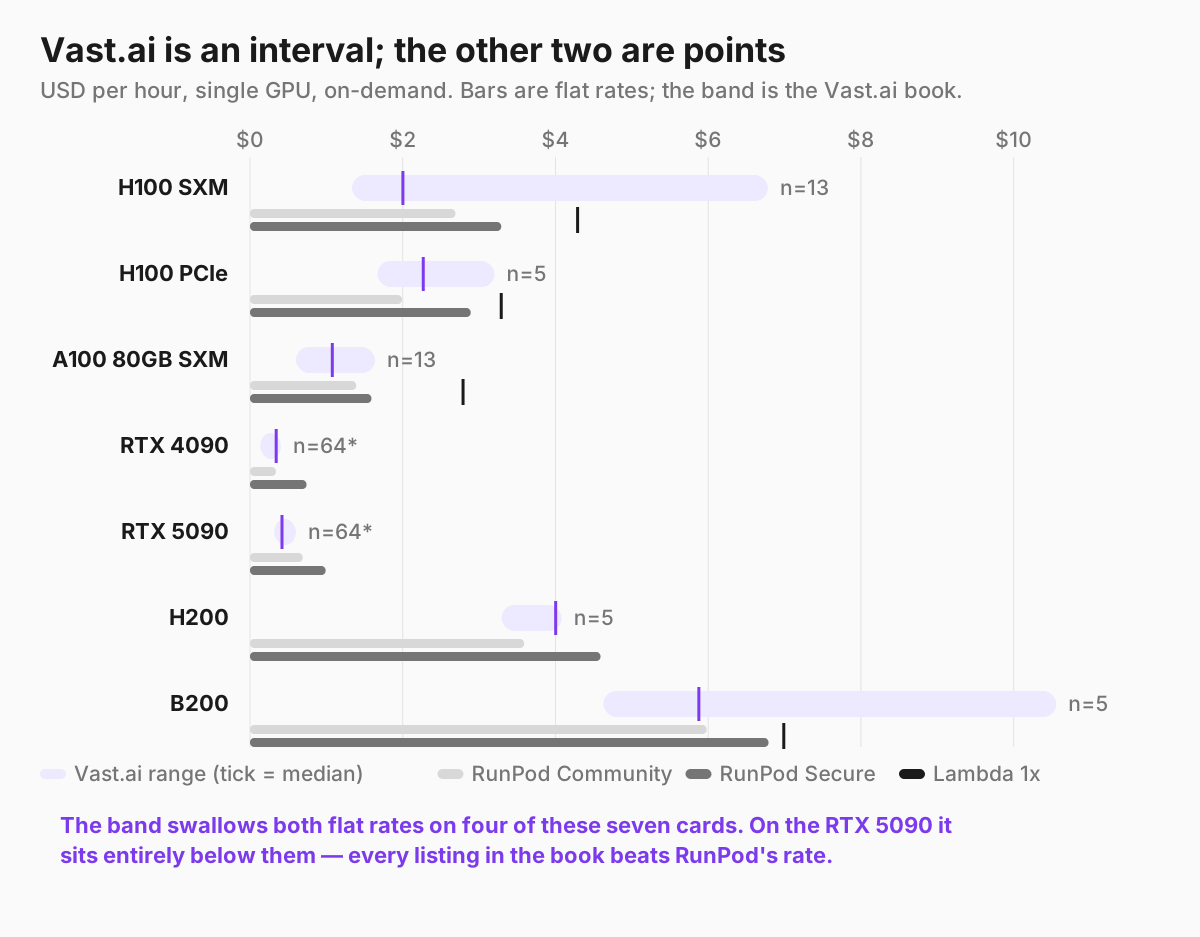
Four things fall out of the table.
The RunPod tier premium is per-card, not per-platform. It ranges from $0.20 on A100 80GB to $1.00 on H200. As a share of the Community rate that runs from 14% to 45%, so there is no single number to carry in your head — check the card you actually want.
Lambda has no consumer tier. It rents datacenter silicon only, so there is no RTX 4090 or 5090 at any price. RunPod and Vast.ai own that segment outright.
On A100 80GB, the comparison isn't like-for-like. RunPod Community's $1.39 is almost exactly half Lambda's $2.79 — but Lambda's A100 80GB exists only as an 8-GPU instance, so the cheapest A100 80GB hour you can actually buy there is eight of them.
On B200, don't trust the median at all. Only five single-GPU listings existed at sample time, and I sampled twice a few minutes apart: the median moved from $6.81 to $5.88, crossing RunPod's flat $5.98 in the process. On a book that thin, the middle of the distribution is noise. What does hold is the shape — $4.63 at the bottom, $10.56 at the top, and a flat $5.98 sitting inside that spread with no shopping required.
Worked example: a 24-hour H100 SXM fine-tune
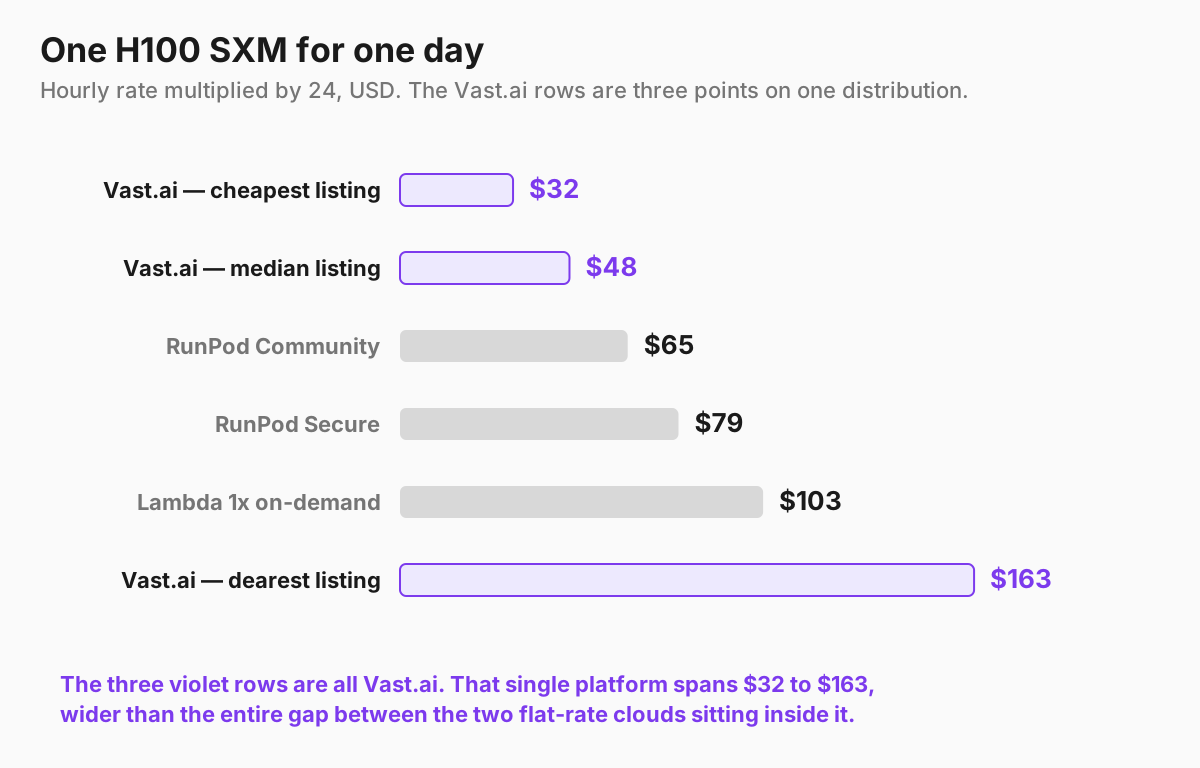
One H100 SXM, running for a full day. The Lambda row is the single-GPU rate, because a single-GPU job is what this example is.
| Platform | Rate | 24h cost |
|---|---|---|
| Vast.ai (cheapest listing) | ~$1.34/hr | ~$32 |
| Vast.ai (median listing) | ~$2.00/hr | ~$48 |
| RunPod Community | $2.69/hr | ~$65 |
| RunPod Secure | $3.29/hr | ~$79 |
| Lambda (1x on-demand) | $4.29/hr | ~$103 |
| Vast.ai (dearest listing) | ~$6.78/hr | ~$163 |
Ignore the last row and that's a 3.2x spread end to end. Put it back and the interesting part appears: the Vast.ai book alone runs $32 to $163 a day, which is wider than the entire flat-rate field ($65 to $103) sitting inside it. Most of the variance here is within one platform, not between three — which is why "Vast.ai is cheaper" is a claim about a listing you found, never about the platform.
How to choose
Work through four questions in order:
- Single GPU or a cluster? Need many GPUs with fast interconnect for distributed training → Lambda's 1-Click Clusters. A single card → all three compete, but check the configuration column first: Lambda's per-GPU rate assumes an 8-GPU instance on several cards, and on A100 80GB there is no 1x option at all.
- Can your job survive an interruption? Yes → Vast.ai interruptible is the cheapest path available anywhere here. No → on-demand on any of the three, and RunPod Secure or Lambda for the steadiest uptime.
- Do you need a fixed number before you start? RunPod and Lambda post one. On Vast.ai, either budget against the median listing rather than the cheapest, or use Reserved and prepay for a fixed rate.
- Datacenter or consumer silicon? A 4090 is plenty for a lot of fine-tuning and inference, and a 5090 costs $0.69/hr on RunPod Community against the 4090's $0.34 — worth it only if the extra memory or throughput actually unblocks your model. Either way, only RunPod and Vast.ai rent consumer cards.
Final verdict
The TL;DR sorts by workload. Here's what it leaves out — the three things most likely to make your actual bill diverge from the table above.
Price the storage before the GPU.
RunPod's storage is published and fixed, and its one sharp edge is that idle Volume Disk ($0.20/GB/month) costs double the running rate ($0.10). Vast.ai's is host-set and spans a factor of several thousand between the cheapest and most expensive host, keeps billing while your instance is stopped, and charges bandwidth in both directions. Lambda charges nothing for ingress or egress.
For a short compute-bound job none of this matters; for a data-heavy pipeline it can invert the ranking outright.
RunPod's Community tier is a closed pool. RunPod is no longer accepting new hosts for it. The cheap column in every RunPod comparison — including this one — is drawn from a supply that isn't growing. Plan around Secure Cloud rates if your usage will scale.
Read Lambda's rates as configurations, not prices. $3.99/hr for an H100 SXM is an 8-GPU rate; the single-GPU rate is $4.29, and A100 80GB doesn't have a single-GPU rate at all. Comparing Lambda's headline against a single Vast.ai listing is comparing a cluster to one card.
And re-check all three official pages right before you launch. RunPod and Lambda flat rates shift occasionally; on Vast.ai the listing you priced against may simply have been rented by someone else.
FAQ
Is Vast.ai safe to use?
It can be, if you choose carefully. Vast.ai shows a reliability score, a DLPerf benchmark, and a verified-datacenter flag for every host. Stick to verified datacenter hosts with high reliability scores for sensitive work, and treat unverified hosts as best-effort.
Note also what the platform does and doesn't promise: on-demand instances come with "guaranteed resources (high priority)", which is a statement about scheduling priority, not a guaranteed-uptime SLA.
What does per-second billing actually mean?
RunPod and Vast.ai bill per second; Lambda bills per minute; RunPod's serverless endpoints bill per second rounded up, from worker start to full stop. Rates are quoted per hour regardless, so a 10-minute job on a per-second platform costs about a sixth of the hourly rate rather than a full hour.
Two caveats: RunPod flex workers have a default 5-second idle timeout that is billable, and storage keeps billing on all three whether or not anything is running.
What are interruptible (spot) instances, and does Vast.ai have anything else?
Interruptible instances are preemptible: you get a much lower rate — Vast.ai advertises "often 50%+ cheaper" — in exchange for the host's right to reclaim the GPU. They're ideal for checkpointed training and batch jobs that can resume, and a poor fit for anything that must run uninterrupted.
Vast.ai also sells Reserved capacity: "Discounted rates with pre-payment", up to 50% off, on 1-, 3-, or 6-month terms — a fixed-price option on a marketplace platform. RunPod and Lambda don't offer spot; every instance is on-demand.
Do storage and egress costs change the comparison?
For data-heavy work, yes, and they can reverse it. RunPod charges $0.05–$0.14/GB/month for network volumes, $0.10 for container disk, and $0.10 running / $0.20 idle for volume disk. Vast.ai's storage and bandwidth are set per host and vary by orders of magnitude — and its storage charges continue while an instance is merely stopped, so you have to delete the instance to stop paying.
Lambda charges no ingress or egress fees at all. For a short compute-bound job these are rounding errors; for a long-running pipeline that moves datasets in and out, price them in before you pick on hourly rate.
References
- RunPod pricing
- RunPod docs — Serverless billing (per-second, rounded up; flex worker idle timeout)
- RunPod docs — Secure Cloud vs Community Cloud (tier differences; new-host policy)
- Lambda pricing
- Lambda docs — billing (per-minute increments; ingress and egress fees)
- Vast.ai pricing
- Vast.ai docs — pricing mechanics (on-demand, interruptible, and reserved modes; storage and bandwidth billing)