TL;DR
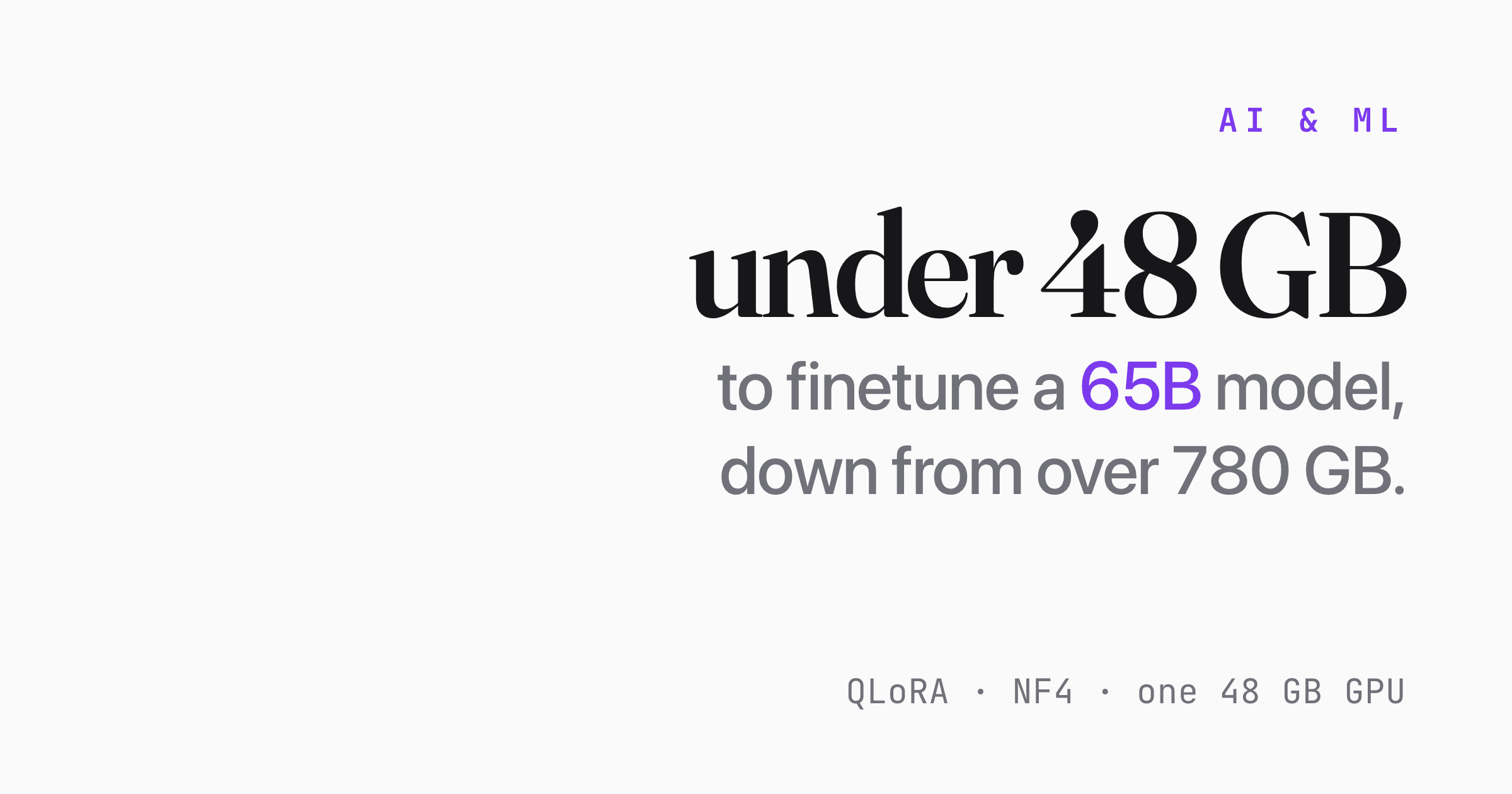
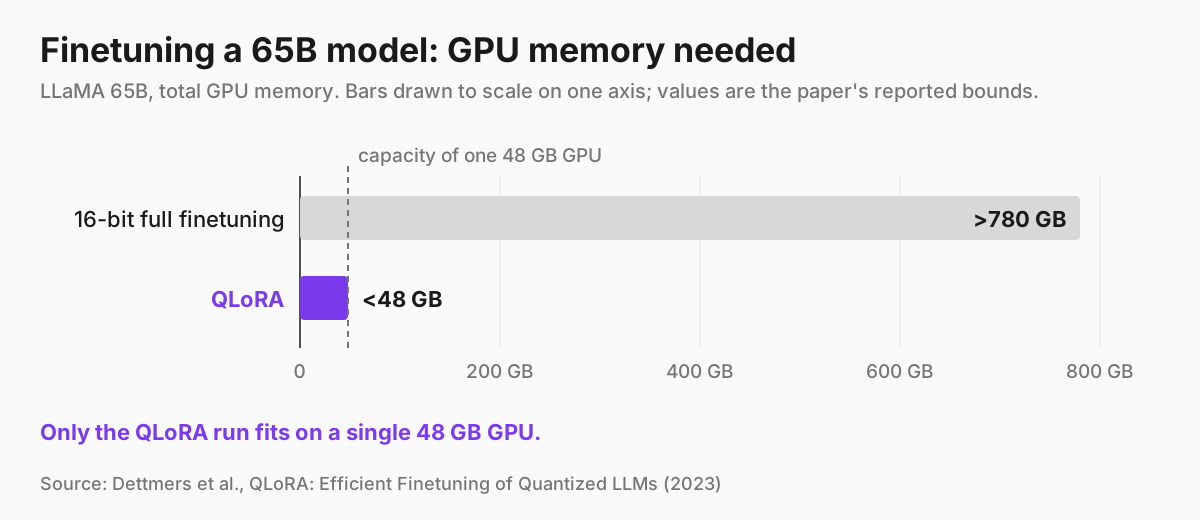
— QLoRA finetunes a large language model by storing its frozen weights in 4-bit and backpropagating only into small 16-bit LoRA adapters. That drops the memory needed to adapt a 65B model from over 780 GB to under 48 GB — a single GPU instead of a multi-GPU cluster.
The paper reports no quality loss versus 16-bit finetuning — though, as the authors are careful to note, that equivalence is measured at smaller scales and extrapolated at 33B and 65B. The chatbot it produced, Guanaco 65B, reaches 99.3% of ChatGPT's score on the Vicuna benchmark after roughly 24 hours on one GPU.
The problem
Finetuning a model the normal way means loading every weight in 16-bit precision and updating all of them. For a 65B-parameter model like LLaMA 65B, that needs more than 780 GB of GPU memory once you count the weights, gradients, and optimizer state. No single GPU comes close.
You rent a cluster, or you don't finetune the model at all — which is exactly where most researchers and small teams were stuck.
Parameter-efficient methods were supposed to fix this. LoRA freezes the base weights and trains a pair of small low-rank matrices per layer, so the gradients and optimizer states shrink dramatically. But there's a catch the headline numbers tend to gloss over: the frozen base model still has to sit in 16-bit memory the whole time.
For a 65B model that base is the dominant cost, so LoRA alone doesn't get you onto one GPU.
QLoRA asks the obvious follow-up question. Can you shrink that frozen base to 4-bit without wrecking the finetune? Naively, no — 4-bit quantization throws away enough precision that training quality usually suffers. The paper's contribution is making it work anyway.
How it works
The core mechanic is simple to state. Keep the base model frozen and quantized to 4-bit. During the forward and backward passes, dequantize each layer's weights back to a compute dtype (BFloat16) on the fly, run the math, and discard the 16-bit copy immediately.
Gradients flow through that 4-bit base but never update it — they land only on the LoRA adapters, which stay in 16-bit and are the only thing the optimizer touches. The static memory footprint is tiny because the bulk of the model lives in 4-bit; the expressiveness stays high because the actual gradient computation happens in 16-bit.
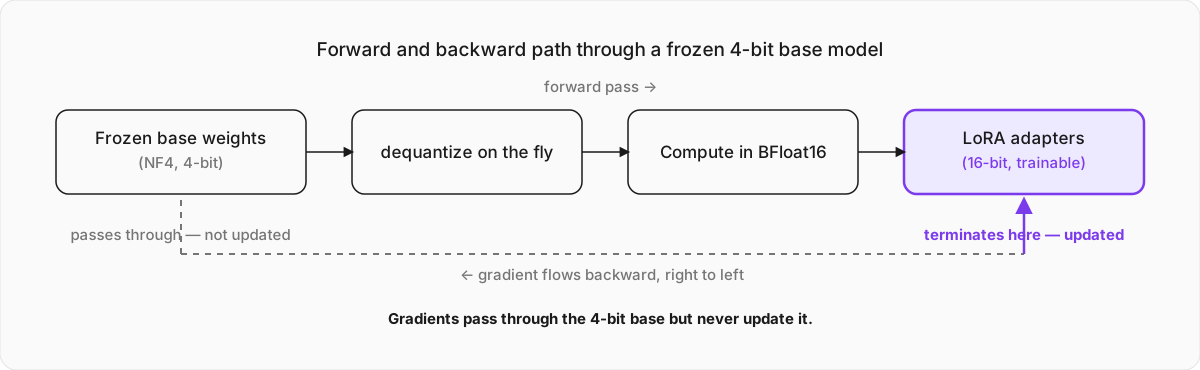
Three engineering pieces make the 4-bit part survive contact with reality.
4-bit NormalFloat (NF4).
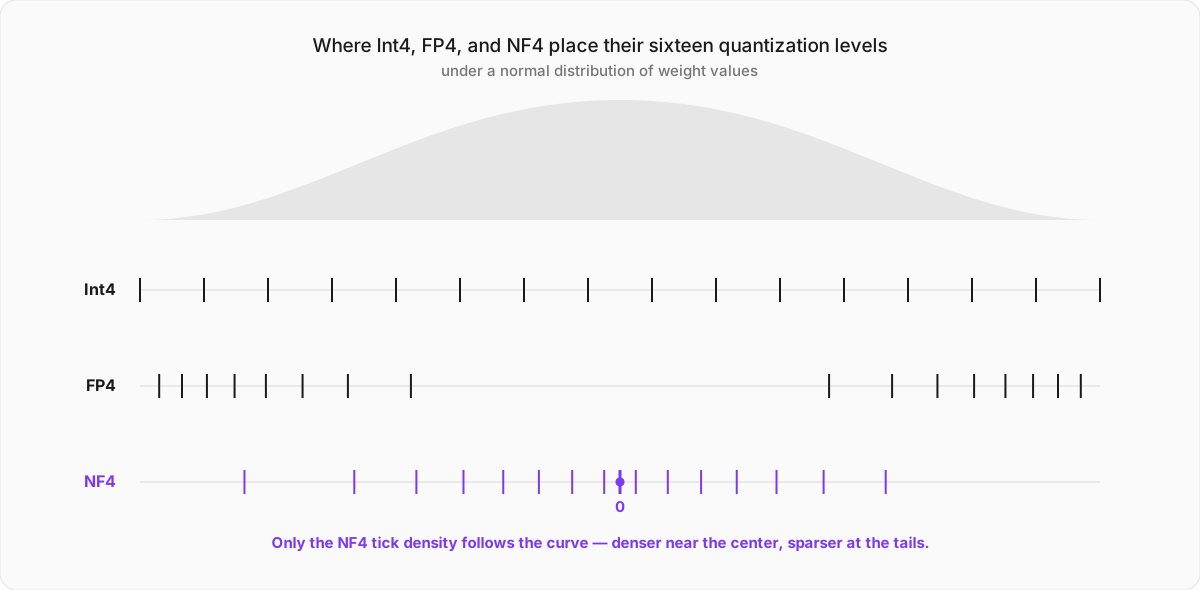
Pretrained weights are roughly zero-centered and normally distributed. Standard 4-bit integers space their 16 levels evenly, and 4-bit floats space theirs by exponent — neither is matched to how weight values are actually distributed, so both waste resolution. NF4 instead sets its levels at the quantiles of a standard normal distribution, which makes it information-theoretically optimal for zero-centered normally distributed weights.
In the paper's experiments NF4 measurably beats FP4 and Int4 on quantization precision.
Double Quantization (DQ). Block-wise quantization produces a scaling constant per block, and those constants add up. DQ quantizes the quantization constants themselves, saving about 0.37 bits per parameter on average — roughly 3 GB on a 65B model — with no measurable performance hit.
Paged Optimizers.
Gradient checkpointing on long sequences causes sharp memory spikes that can trip an out-of-memory crash. Paged optimizers use NVIDIA unified memory to automatically move optimizer state between GPU and CPU during those spikes, the same way the OS pages RAM to disk, so training rides through the peaks instead of dying.
The authors note they didn't measure this precisely — paging is rare — but report no training-speed penalty at batch size 16.
There's one design finding worth pulling out, because it overturns earlier PEFT intuition. To match full 16-bit finetuning quality, you have to attach LoRA adapters to every linear layer, not just the attention query and value projections as the original LoRA paper did. Once you do that, adapter rank stops being the bottleneck.
The thing that had been limiting earlier parameter-efficient methods was how many adapters were used — coverage, not capacity.
Put together, finetuning a 65B model drops from more than 780 GB to under 48 GB — it fits on one 48 GB card — while preserving 16-bit task performance.
Results
The headline accessibility number is the 65B finetune on a single 48 GB GPU. The smaller Guanaco models need far less; the paper reports the 7B at a 5 GB deployed footprint — small enough to sit on a phone — and the authors estimate QLoRA could finetune 3M tokens per night on an iPhone 12 Plus.
On quality, the central claim is that 4-bit doesn't cost you anything when done right.
| Claim | Result reported in the paper |
|---|---|
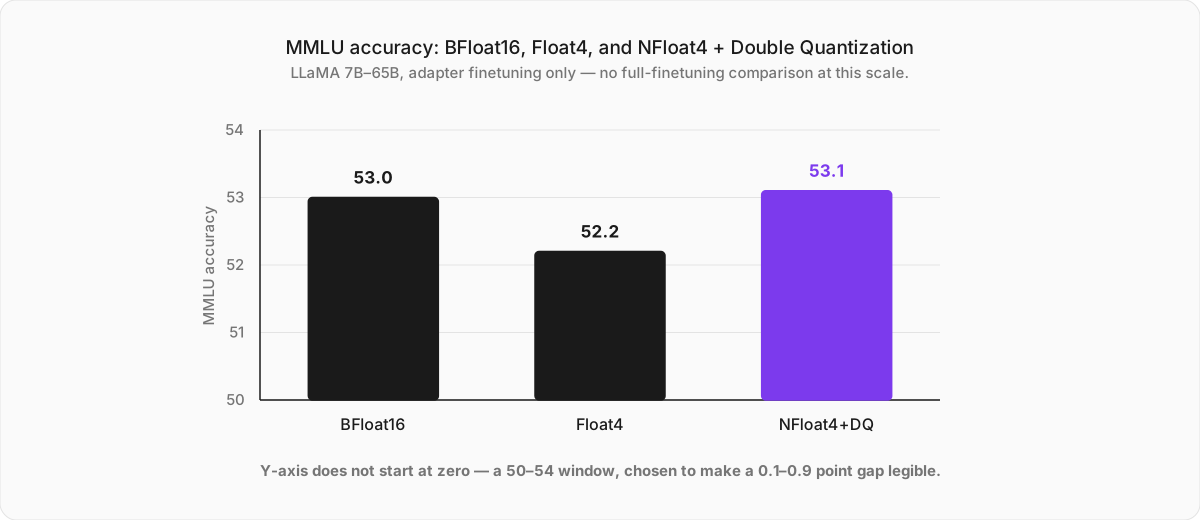
| NF4 vs 16-bit LoRA, MMLU (5-shot) | NF4 + Double Quantization matches the BFloat16 LoRA baseline across LLaMA 7B–65B (mean 53.1 vs 53.0), while Float4 trails both at 52.2. No full-finetuning comparison was run at this scale — Table 4 |
| NF4 vs full finetuning | Separately established on RoBERTa-large (GLUE) and T5 80M–11B (Super-NaturalInstructions), where 16/8/4-bit adapters all replicate the fully finetuned 16-bit baseline — Table 3 |
| FP4 vs NF4 | FP4 trails the BFloat16 LoRA baseline by ~1 point, confirming NF4 > FP4 |
| Guanaco 65B (Vicuna benchmark, GPT-4 judged) | 99.3% of ChatGPT (GPT-3.5-turbo), trained in ~24 hours on one GPU |
| Guanaco 33B | ~97.8% of ChatGPT, far cheaper to train |
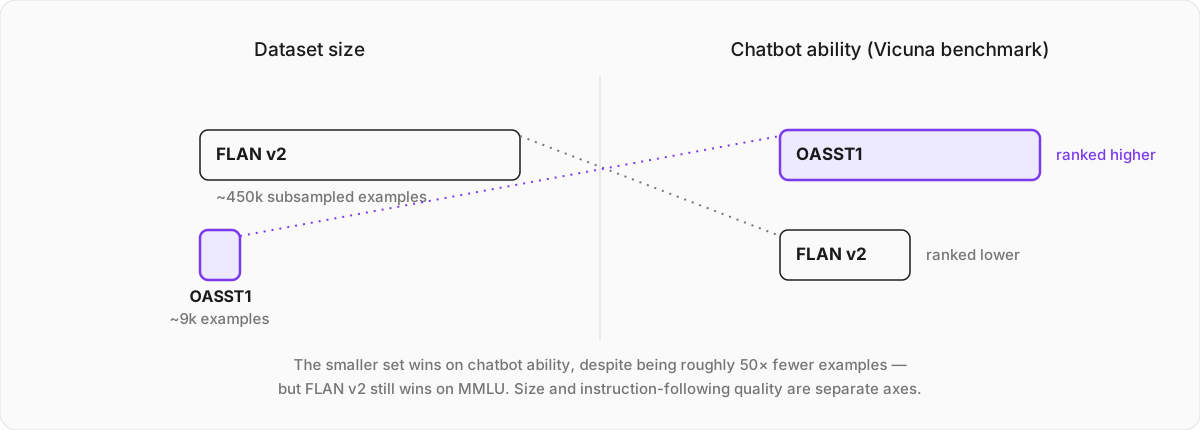
| Data quality vs quantity | ~9k high-quality OASST1 examples beat ~450k examples subsampled from FLAN v2 for chatbot ability |
A couple of these deserve more than a table cell. The data-quality result is the one I'd flag for anyone building their own finetune: the best dataset depends on what you're optimizing for, and the two goals pull apart.
A model that scores well on MMLU is not automatically a good chatbot, and the dataset that makes a great chatbot (OASST1) is not the one that maxes MMLU (FLAN v2). Bigger is not better; relevant is better.
On evaluation rigor, the authors used two judges — GPT-4 and human annotators — and aggregated their pairwise verdicts into Elo rankings rather than relying on absolute scores. The two agree only moderately: Kendall τ=0.43 and Spearman r=0.55 at the system level, dropping to Fleiss κ=0.25 at the individual-example level, with Guanaco 7B a notable point of disagreement.
The authors present GPT-4 judging as a cheap but imperfect stand-in for human evaluation, not as a confirmation of it. And the scale of the study is itself part of the argument: they trained over 1,000 models across sizes and datasets — an analysis that would have been infeasible with regular full finetuning.
QLoRA isn't just a way to train one big model cheaply; it's a way to run the kind of broad sweep that answers research questions.
Limitations and context
The paper is unusually candid about what it didn't prove, and it's worth reading the 99.3% figure with that in mind.
The equivalence to full 16-bit finetuning is established at smaller scales and inferred at 33B and 65B — the authors say outright that compute cost stopped them from directly confirming it at the top end. So "QLoRA matches full finetuning" is solidly demonstrated for smaller models and a reasonable extrapolation, not a measured fact, for the largest ones.
They also argue against their own headline. The paper makes the case that current chatbot benchmarks — Vicuna and MMLU included — aren't fully trustworthy for ranking models, and that GPT-4 as a judge shows a strong order effect — it favors whichever system appears first — and rates its own outputs far higher than humans do (Elo 1348 versus 1176).
The "99.3% of ChatGPT" number is benchmark-relative, not an absolute statement that Guanaco is 99.3% as good as ChatGPT in any deep sense.
On safety, the analysis is deliberately limited: they run a single benchmark, CrowS-Pairs, across nine bias categories. Guanaco-65B actually scores well — an average of 43.5 versus 66.6 for the LLaMA-65B base model, suggesting OASST1 finetuning reduced the base model's bias.
But the authors are careful to say it is unclear whether this holds for bias types the benchmark doesn't cover, and they leave broader responsible-AI evaluation to future work.
One framing worth getting right: QLoRA is a memory win, not a speed win. The paper reports it reaches <48 GB without degrading runtime versus a 16-bit baseline, but it never claims a throughput improvement.
The 4-bit base does shrink the deployed model too — the paper notes Guanaco 33B at 21 GB against Vicuna 13B's 26 GB — so this is not purely a training-side benefit. If what you need is faster serving rather than smaller memory, this isn't the lever.
Why it matters
QLoRA changed who gets to finetune large models. Adapting a 65B model went from a datacenter job to something a single person could run on one GPU overnight, and the field noticed immediately.
NF4, double quantization, and paged optimizers shipped as open source alongside the paper, and 4-bit adapter finetuning has since become a common recipe in the community stack that grew around bitsandbytes, Hugging Face transformers, and peft.
The methodological influence ran alongside the technical one. The data-quality-over-quantity finding reframed how people think about instruction datasets, and the GPT-4-plus-human evaluation with Elo aggregation offered a reusable playbook for judging chat models.
References
- Dettmers, T., Pagnoni, A., Holtzman, A., Zettlemoyer, L. QLoRA: Efficient Finetuning of Quantized LLMs. NeurIPS 2023. arXiv:2305.14314 — https://arxiv.org/abs/2305.14314 (PDF)
- Reference implementation and models — https://github.com/artidoro/qlora (methods upstreamed into Hugging Face
bitsandbytes/transformers/peft)