If you're comparing these three in 2026, two facts reshape the question before you look at a single feature.
Windsurf no longer ships under that name. Cognition, the company behind the Devin agent, bought Windsurf in 2025 and pushed an over-the-air rebrand to Devin Desktop on June 2, 2026. Settings, extensions and plans carried over; the editor, agent and roadmap did not.
Cursor is now owned by SpaceX. The acquisition closed on August 14, 2026, completing a process that began with a model-training partnership in April. You can see it in the product: Cursor's own first-party models are now Grok and Composer, and they sit on a separate, more generous usage allowance than third-party models.
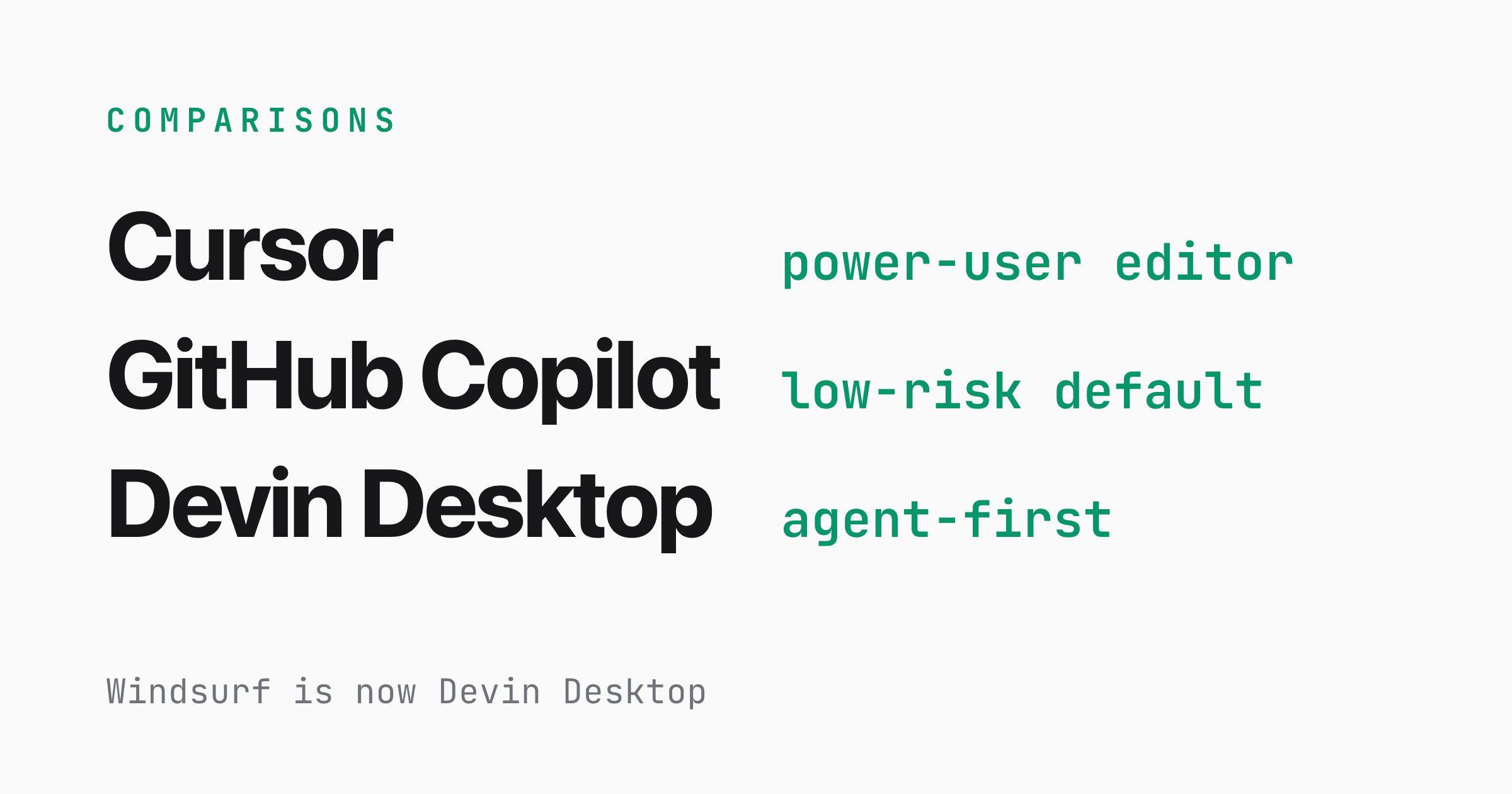
So the real 2026 comparison is Cursor, GitHub Copilot, and Windsurf-now-Devin-Desktop. Here's who each one is for.
At a glance (verified September 28, 2026)
| Cursor | GitHub Copilot | Windsurf → Devin Desktop | |
|---|---|---|---|
| Owner | SpaceX (since Aug 2026) | GitHub / Microsoft | Cognition |
| Free tier | Hobby — limited Agent requests, access to Composer | Free — 2,000 completions + 50 chat requests/mo | Free — light daily/weekly quota, unlimited Tab |
| Entry paid | Pro $20/mo | Pro $10/mo | Pro $20/mo (was $15 before Mar 2026) |
| Higher tiers | Pro Plus $60 · Ultra $200 | Pro+ $39 · Max $100 | Max $200/mo |
| Team plan | Standard $40/user · Premium $120/user (5× Agent limits) | Business $19/seat · Enterprise $39/seat | $80/mo base + $40 per full seat, up to 200 users |
| Billing model | Two pools: Cursor's own models (Grok, Composer) with more included usage; third-party models at API price | AI Credits (1 credit = $0.01) since June 1, 2026; part of each allotment is "flex" | Daily/weekly quotas; extra usage at API pricing |
| Form factor | Standalone VS Code fork, plus cloud agents | Plugin across many IDEs, plus github.com | Standalone editor (VS Code-based) |
| Signature models | Grok and Composer (first-party) | Multi-vendor | SWE-2 |
Prices move fast in this space. Everything above was checked against each vendor's pricing page on the date shown — confirm before you commit.
Cursor — the power-user editor
Cursor is a standalone VS Code fork built around AI-native editing, and it leans hardest into the "live in the editor all day" workflow. Paid plans also include cloud agents and Bugbot, its code-review agent.
The thing to understand in 2026 is how usage is billed, because it changed. There are now two separate allowances. Cursor's own models — Grok and Composer — draw from a pool with "significantly more included usage". Third-party models such as Claude, GPT and Gemini draw from a second pool, charged at each model's API price. Pro, Pro Plus and Ultra include both, and you can pay for more when you run out.
That changes the old advice about Auto mode. Auto used to be the thrifty choice. Now, per Cursor's docs, "all Auto modes bill at the list price of the model each request is routed to" — so Auto is only cheap when it routes to Cursor's own models. If cost matters, choose Cursor's first-party models deliberately and reach for third-party frontier models when you need them.
Two smaller changes: unlimited Tab completion is a paid-plan feature (Pro, Pro Plus, Ultra), and teams now choose between Standard seats at $40 and Premium seats at $120 with five times the Agent limits. In India there is also a Start plan at ₹649 a month that covers Cursor's own models only.
GitHub Copilot — the low-risk default
Copilot is the safe pick when switching editors is a non-starter. It runs as a plugin across VS Code, JetBrains, Visual Studio, Xcode, Neovim and more, and on github.com, and it stays the most tightly wired into pull requests and the rest of the GitHub workflow. It is also the broadest on models, routing across several vendors; the current list is on GitHub's supported-models page.
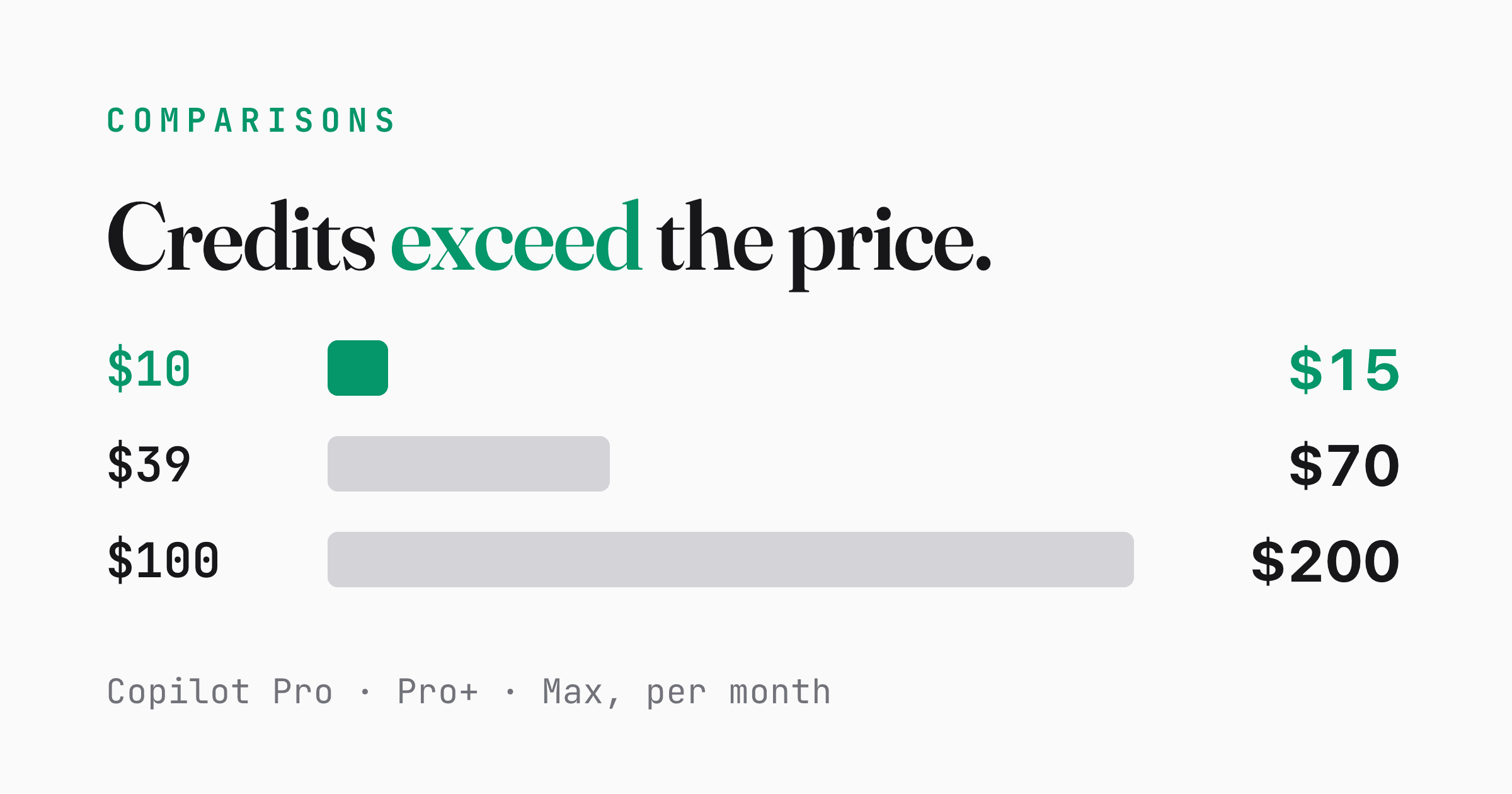
The big 2026 change is billing. Since June 1, 2026, plans bill on AI Credits (1 credit = $0.01), with a monthly allotment included. There is a detail most comparisons miss: part of each allotment is a "flex" amount, and GitHub's plans page says plainly that "flex allotments may change over time."
| Plan | Price | Included credits | Of which guaranteed | Flex |
|---|---|---|---|---|
| Pro | $10/mo | $15 | $10 | $5 |
| Pro+ | $39/mo | $70 | $39 | $31 |
| Max | $100/mo | $200 | $100 | $100 |
So the dependable figure is the plan price, not the headline credit total.
What softens the change: code completions and next edit suggestions "don't use credits" and stay unlimited on every paid plan; only the heavier chat and agent features meter against your balance. For teams, Business is $19 per seat (1,900 credits) and Enterprise $39 per seat (3,900 credits).
One gate worth knowing: delegating tasks to third-party coding agents like Anthropic's Claude and OpenAI's Codex (in preview) requires Pro+ or Max, not Pro.
Windsurf → Devin Desktop — agent-first
Cognition announced its acquisition of Windsurf on July 14, 2025, and the editor became Devin Desktop on June 2, 2026. The rebrand is complete now — the old Cascade agent reached end of life on July 1, 2026, replaced by Devin Local. The pitch is autonomy: hand a whole task to Devin and let it work, then use Codemaps to navigate large codebases.
It also supports the Agent Client Protocol (ACP), so you can run Codex, Claude Agent, OpenCode and other ACP agents inside the same editor — useful if you don't want to be locked to one vendor's agent.
Devin Desktop is now sold as part of a single Devin plan that also covers Devin Cloud. Every plan includes it; paid plans come with a usage allowance that refreshes daily and weekly, and extra usage is billed at API pricing. Cognition's latest in-house coding model is SWE-2, alongside frontier models from other vendors.
Team pricing changed shape: rather than a flat per-user price, Teams is an $80 monthly base plus $40 per full developer seat, for up to 200 users.
Which should you pick
Pick Cursor if you're an individual power user or a small team that wants the most capable AI-native editor and plans to live inside it. To keep spend predictable, lean on Cursor's own models, which carry the larger included allowance, rather than routing everything to third-party frontier models.
Pick GitHub Copilot if you're on a team already in the GitHub ecosystem, want to keep your current IDE, and value model choice plus low switching risk. It's the cheapest way in at $10 — budget on the plan price rather than the headline credit total, since part of that total is flex.
Pick Devin Desktop (ex-Windsurf) if you want the most autonomous, agent-first workflow: delegating whole tasks to Devin Local or Cloud and using Codemaps on big repos.
Short version: Cursor is the best AI-native editor for power users, Copilot is the safest team and ecosystem default, and Devin Desktop is the most autonomous agent-first IDE.
FAQ
Is Windsurf discontinued?
Not discontinued — renamed. Cognition rebranded Windsurf to Devin Desktop on June 2, 2026 through an over-the-air update, and settings, extensions and subscriptions carried over. The old Cascade agent was retired on July 1, 2026 in favor of Devin Local.
Who owns Cursor now?
SpaceX. Cursor announced the acquisition was complete on August 14, 2026. The visible effect is in the models and billing: Cursor's first-party models are Grok and Composer, and they get a larger included allowance than third-party models.
Is Cursor or Copilot cheaper?
Copilot has the lower entry price at $10/mo versus Cursor's $20/mo. But both meter heavier use — Copilot through AI Credits, Cursor through its two usage pools — so the real cost depends on how much agent work you do and which models you pick. For light, completion-heavy use Copilot wins on price; for constant agent work the gap narrows.
Did GitHub Copilot get more expensive?
The plan prices didn't change, but the billing model did. Since June 1, 2026 plans bill on AI Credits, so heavy chat and agent use can run past your included allotment, and part of that allotment is flex that GitHub says may change. Code completions and next edit suggestions still don't use credits.
Can I run Claude or Codex agents inside these editors?
Yes, depending on the tool. Copilot can delegate to Claude and Codex agents on its Pro+ and Max plans. Devin Desktop supports ACP, so you can run Codex, Claude Agent and OpenCode inside the editor. Cursor lets you pick third-party frontier models inside its own agent, billed at API price.
References
- Cursor has joined SpaceX — Cursor blog
- Cursor pricing · Cursor models and pricing docs
- GitHub Copilot plans · Copilot plans in GitHub Docs · Supported models
- GitHub Copilot is moving to usage-based billing
- Devin pricing · Windsurf is now Devin Desktop · Devin Desktop FAQ
- Cognition's acquisition of Windsurf