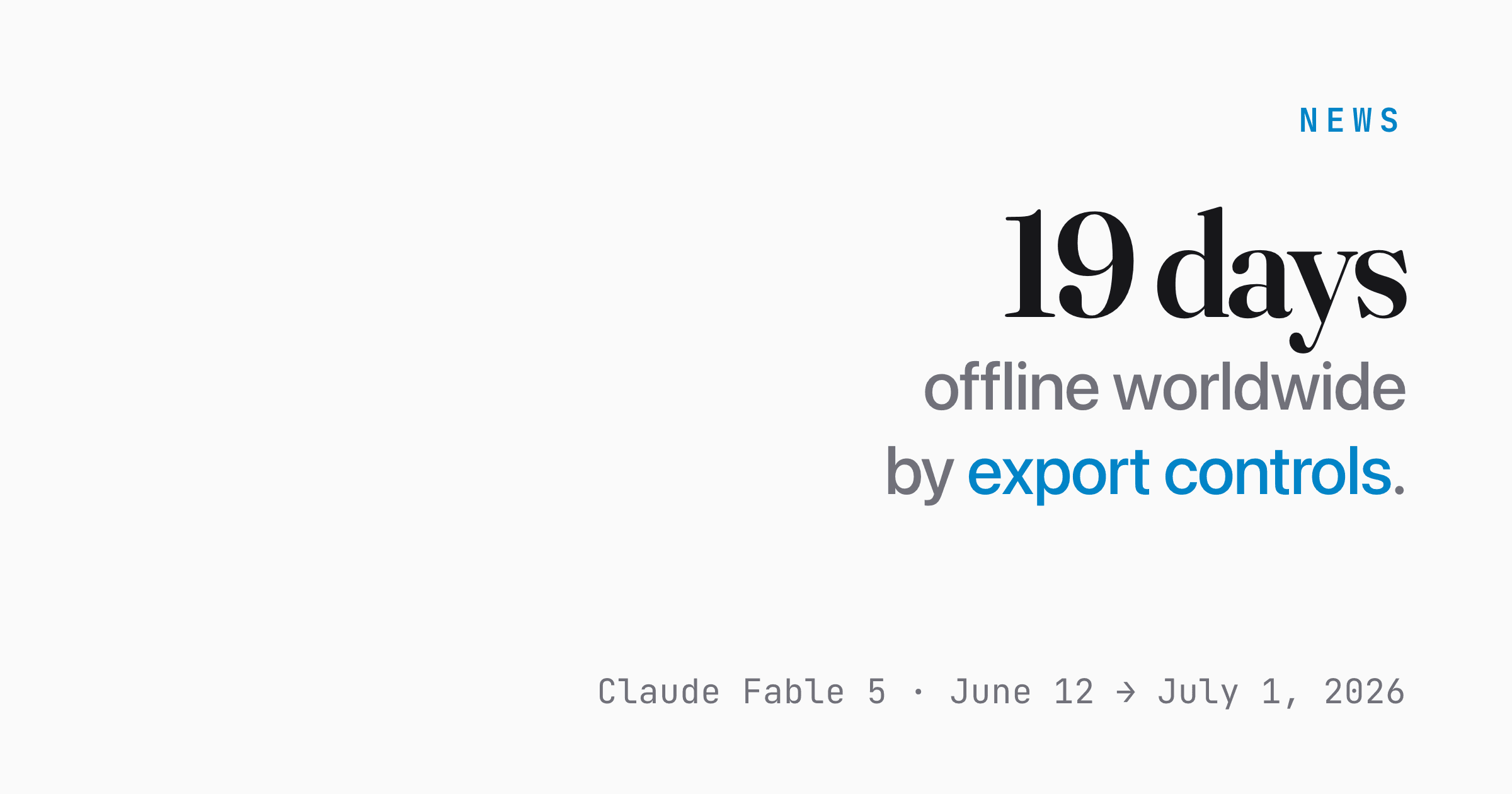
Anthropic switched Claude Fable 5 back on for everyone on July 1, ending a 19-day outage that no SLA anticipated and no status page could explain. The model that returned is not quite the one that went dark on June 12.
It carries a new cybersecurity classifier that silently reroutes flagged requests to Claude Opus 4.8, and the subscription access that came back with it is on a timer: included usage runs only through July 7, then shifts to usage credits.
The launch-day story has been told. What matters now is the follow-up: what exactly changed in the redeployed model, how access works this week, and what a government-ordered global shutdown of a commercial AI model teaches anyone who builds on one.
How a jailbreak report became a 19-day blackout
Fable 5 and its unrestricted sibling, Claude Mythos 5, launched on June 9. Three days later the US government applied export controls to both.
The controls required restricting access for foreign nationals and took effect immediately — and because Anthropic had no reliable way to verify a user's nationality in real time, it did the only compliant thing it could: suspend both models for all users, worldwide.
The trigger was a report from Amazon researchers describing a jailbreak that got Fable 5 to identify software vulnerabilities and, in one case, produce code demonstrating how one of them could be exploited.
Anthropic's counterargument, maintained throughout, is that less capable models — its own Claude Opus 4.8, OpenAI's GPT-5.5, and Kimi K2.7 — produced similar results in its testing, and that the technique did not expose any unique Mythos-level cyber capabilities. The government eventually came around, but it took most of a month:
- June 9 — Claude Fable 5 and Claude Mythos 5 launch
- June 12 — Export controls take effect; both models suspended globally
- June 26 — Mythos 5 restored for a set of US organizations in the Glasswing critical-infrastructure program (press reports put it at roughly 100 companies and federal agencies)
- June 30 — Export controls lifted
- July 1 — Fable 5 redeployed globally on the Claude Platform (API), Claude.ai, Claude Code, and Claude Cowork
What actually changed in the model you get back
The headline change is a new cybersecurity classifier trained against the specific technique in the Amazon report. Anthropic says it blocks that behavior in over 99% of cases. The design decision worth understanding: blocked requests are not refused. They are routed to Claude Opus 4.8, which answers instead.
For context, Fable 5 already shipped with three classifiers at launch — cybersecurity, biology and chemistry dual-use, and anti-distillation — triggering in under 5% of sessions, with the same Opus 4.8 fallback. The redeployment tightens the cyber layer on top of that; bio/chem and anti-distillation behavior is unchanged.
The practical consequence is subtle. If your workload touches vulnerability analysis, exploit triage, or other security-adjacent territory — including work Anthropic itself characterizes as routine defensive cybersecurity — some of your requests may now execute on Opus 4.8 without an error, a header, or any other signal. The response quality changes; nothing tells you why.
If you ran security workflows on Fable 5 before June 12, re-test them rather than assuming continuity.

Anthropic also attached policy commitments to the redeployment: a proposed industry framework for scoring jailbreak severity (capability gain, breadth of that gain, ease of weaponization, discoverability), pre-release government access to national-security-relevant models, rapid information sharing on jailbreaks, dedicated joint research teams, and voluntary security standards across frontier providers.
Read those less as PR and more as a signal of where the regulatory floor is heading — pre-release government review is now something Anthropic has volunteered for.
Access and pricing this week
API pricing is unchanged from launch: $10 per million input tokens, $50 per million output tokens, model ID claude-fable-5. Subscription access is where the clock matters.
| Plan | Right now | After July 7 |
|---|---|---|
| Pro, Max, Team, select Enterprise | Included, up to 50% of weekly usage limits | Usage credits |
| Premium Enterprise seats | Included | Usage credits |
| Standard Enterprise seats | No included allowance | Usage credits |
Two more access notes. Cloud platform availability — AWS, Google Cloud, Microsoft Foundry — is being restored as quickly as possible per Anthropic, which is not the same as live on day one; check your platform before routing production traffic through it. And Mythos 5 remains gated to approved US organizations, with international Glasswing partners still waiting.
The 30-day data retention policy on all Mythos-class traffic, in place since launch for safety purposes, carries over unchanged.
The outage matters more than the comeback
Frontier models have been deprecated, rate-limited, and knocked over by capacity incidents. None had ever been pulled worldwide for 19 days by export controls. This was not an Anthropic reliability failure — the infrastructure was fine — and that is exactly what makes it a new category of risk.
No SLA covered it, and no amount of vendor due diligence on uptime history would have caught it.
Teams that hard-coded claude-fable-5 into products or agent pipelines ate 19 days of degradation with no recourse. The lesson is not avoid Anthropic; the same mechanism could in principle hit any US frontier lab whose model draws a similar report.
The lesson is architectural: put a routing or gateway layer between your product and any single model ID, keep a tested degradation path to an Opus 4.8-class or non-Anthropic model, and treat frontier-model access like a supply-chain dependency with concentration risk — because a government just demonstrated that it is one.

How the field looks after the dust settled
During the outage, the realistic fallbacks were Claude Opus 4.8 (Anthropic's own designated fallback target), OpenAI's GPT-5.5 tier, or Gemini — none of them subject to the controls. That reshuffles how the trade-off reads now:
| Claude Fable 5 | Claude Opus 4.8 | GPT-5.5 / Gemini tier | |
|---|---|---|---|
| Capability | State of the art on nearly all tested benchmarks, per Anthropic (top score on Hebbia's Finance Benchmark; beats Cognition's FrontierCode even at medium effort) | One tier below; the model Fable 5 itself falls back to | Anthropic's own testing found them able to reproduce the jailbreak results |
| Safety rerouting | Classifiers may silently route requests to Opus 4.8 | None | None comparable |
| Regulatory exposure | Demonstrated: 19 days offline by government order | None so far | Not subject to these controls |
| Data retention | 30-day retention on all traffic (safety policy) | Standard Anthropic terms | Provider-dependent |
Anthropic's argument that comparable models could reproduce the jailbreak cuts both ways. It supports the claim that the controls were disproportionate — and it is also a reminder that if Opus 4.8 or GPT-5.5 handled your workloads acceptably for 19 days, you now have real evidence about whether you need the Fable premium at all.
Should you switch back?
If you built on Fable 5 before June 12: yes, but come back with a routing layer this time, and re-run evaluations on anything security-adjacent — the new classifier changes which model actually answers some of your requests.
If you're on Pro, Max, or Team: the included window (up to 50% of weekly limits) is the cheapest evaluation of Fable 5 you will get, and it closes July 7. After that, every Fable token draws down credits, and the decision becomes a budgeting question rather than a toggle.
If you're a security team: treat the redeployed Fable 5 as a new model for testing purposes. The failure mode is not refusals you can catch — it is silent substitution of a different model's output.
If your fallback held up fine: the 19-day forced experiment was free A/B data. Some teams will reasonably conclude that Opus 4.8-class models cover their needs at lower cost and lower regulatory surface, and that is a defensible place to land.
Caveats before you plan around any of this
The tightened classifier will produce false positives on legitimate defensive-security work; Anthropic's own description of the reported technique as routine defensive cybersecurity makes that close to a certainty. The July 7 date makes the included-access window short — if you want to evaluate on subscription allowance, start now. Cloud availability on Bedrock, Google Cloud, and Foundry was still rolling out at redeployment time.
And while the export controls are lifted, the mechanism that produced them is intact: a future jailbreak report could trigger the same sequence again, and now everyone — Anthropic included — knows exactly how fast it can happen.
References
- Redeploying Fable 5 — Anthropic
- Claude Fable 5 and Claude Mythos 5 — Anthropic
- Anthropic says Trump admin has lifted export controls on Claude Fable 5 and Mythos 5 — CNBC
- Anthropic Restores Claude Fable 5 After U.S. Lifts Jailbreak-Linked Export Controls — The Hacker News
- Anthropic starts to restore Claude Fable 5, Claude Mythos 5 after US export controls lifted — Constellation Research
- Anthropic announcement on X