The fastest way to understand what Claude Fable 5 changed is not a benchmark table. It's looking at what people actually shipped with it — which, given the model's strange launch calendar, is a corpus barely three weeks old. Fable 5 landed on June 9, went dark from June 12 to June 30 while Anthropic worked through export-control restrictions, and came back on July 1.
Everything below was built in the narrow windows around that gap.
Two claims dominate that young corpus. First, the one-shot leap: single prompts producing complete, polished artifacts that earlier models needed several rounds of iteration to approach. Second, autonomous endurance: the model running for hours against its own verification tooling without a human steering every step.
Rather than argue either claim in the abstract, here's a small tour of things you can open in a browser right now, drawn from two large verified builds and a 550-project community gallery. Each comes with a practical takeaway you can reuse regardless of which model you run.
The headliner: a procedural 3D world, ~99% written by the model
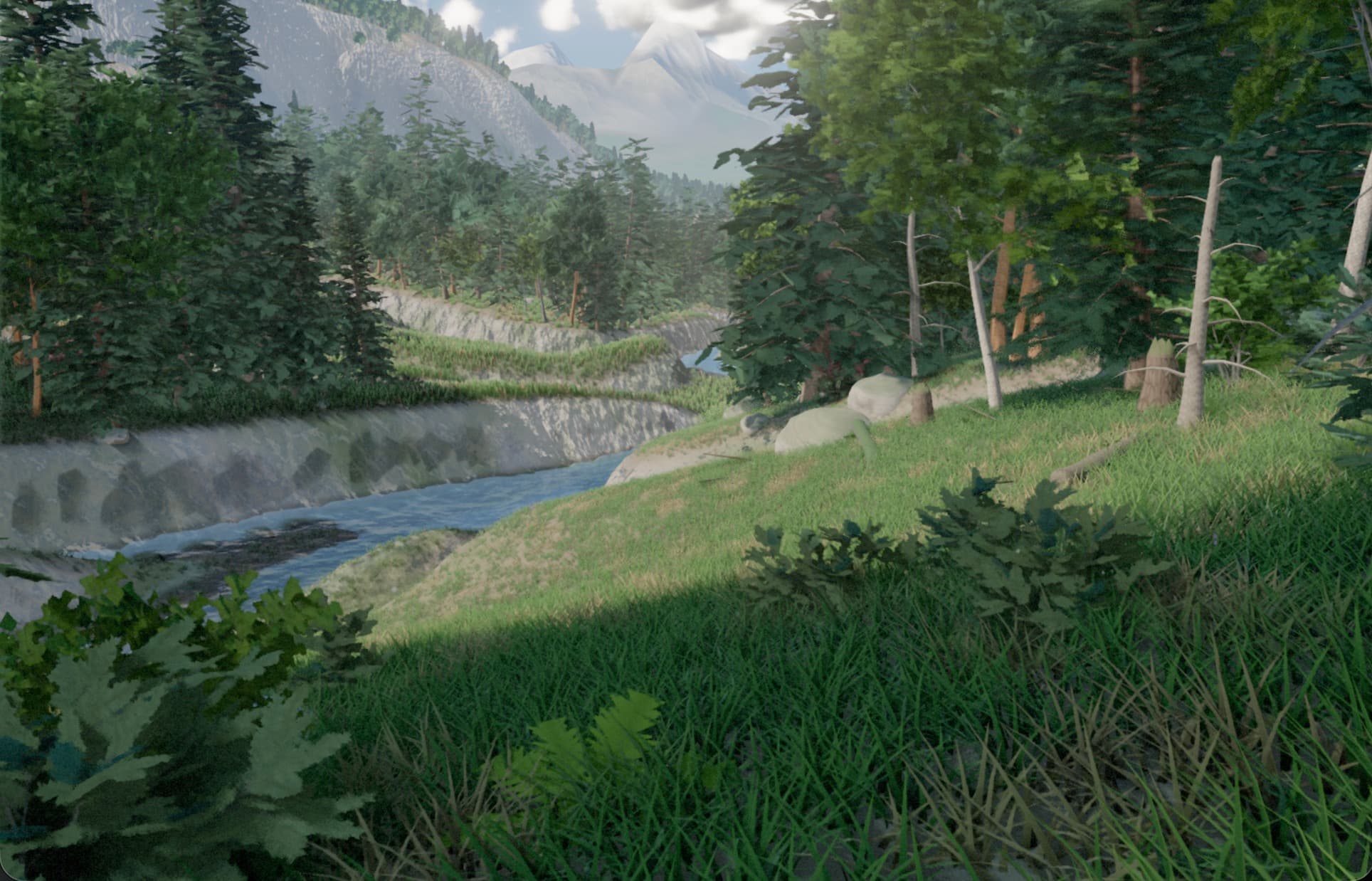
Braffolk's fable5-world-demo is the closest thing the Fable 5 era has to a verified showpiece. It's a fully procedural 4×4 km open world running in the browser: terrain shaped by erosion simulation, procedurally branching trees, a river system, volumetric clouds, atmospheric scattering, shadow mapping with contact shadows.
The stack is three.js's WebGPU renderer with TSL materials and raw WGSL compute shaders — about 21,000 lines of strict TypeScript across 90+ commits. Per the README, roughly 99% of it was written by Claude Fable 5 across long autonomous sessions.
The human contribution was a short project document setting visual references and constraints; the model handled the architecture, every engine and world system, the debugging, the working notes, and the README itself. Every asset in the repo — meshes, textures, lights — is generated procedurally; there isn't a single pre-made image file.
Two details matter more than the spectacle. The first is verification. The model built its own QA rig: it boots the world headless (Playwright driving Chromium with a WebGPU adapter), takes screenshots, samples pixels, diffs frames against baselines with frame-aligned determinism, and profiles GPU passes per encoder. It wasn't grading its own homework by eyeball — it had instruments. The second is memory.
The model maintained a STATUS.md file as durable state between sessions: decisions made, measurements taken, issues still open. That file is how a build this size survives the hard boundary of a context window.
The lesson generalizes past this repo. Give a long-running agent a way to see the consequences of its changes and a place to write down what it knows, and it can carry a genuinely large autonomous build. Withhold those two things and you get the familiar failure mode: confident code that drifts further from working with every session.
The 99% figure is self-reported, but the commit history, the tooling, and the working notes are all public — which is considerably more than most viral AI demos offer.
A second verified corpus: 57 more, one prompt, one day
Braffolk's world isn't the only large-scale build with public receipts. elder-plinius/FABLE-SHOWCASE is a different shape of evidence: instead of one model sustaining one session for weeks, a single prompt in Claude Code fanned out roughly 275 Claude Fable 5 subagent runs in parallel — each pushed through a design → build → enhance → QA pipeline — until a week's worth of API credits ran out, in one day.
The result is 57 self-contained demos, each a single index.html file with zero dependencies: no build step, no CDN, no framework, nothing to install. Open any one directly in a browser.
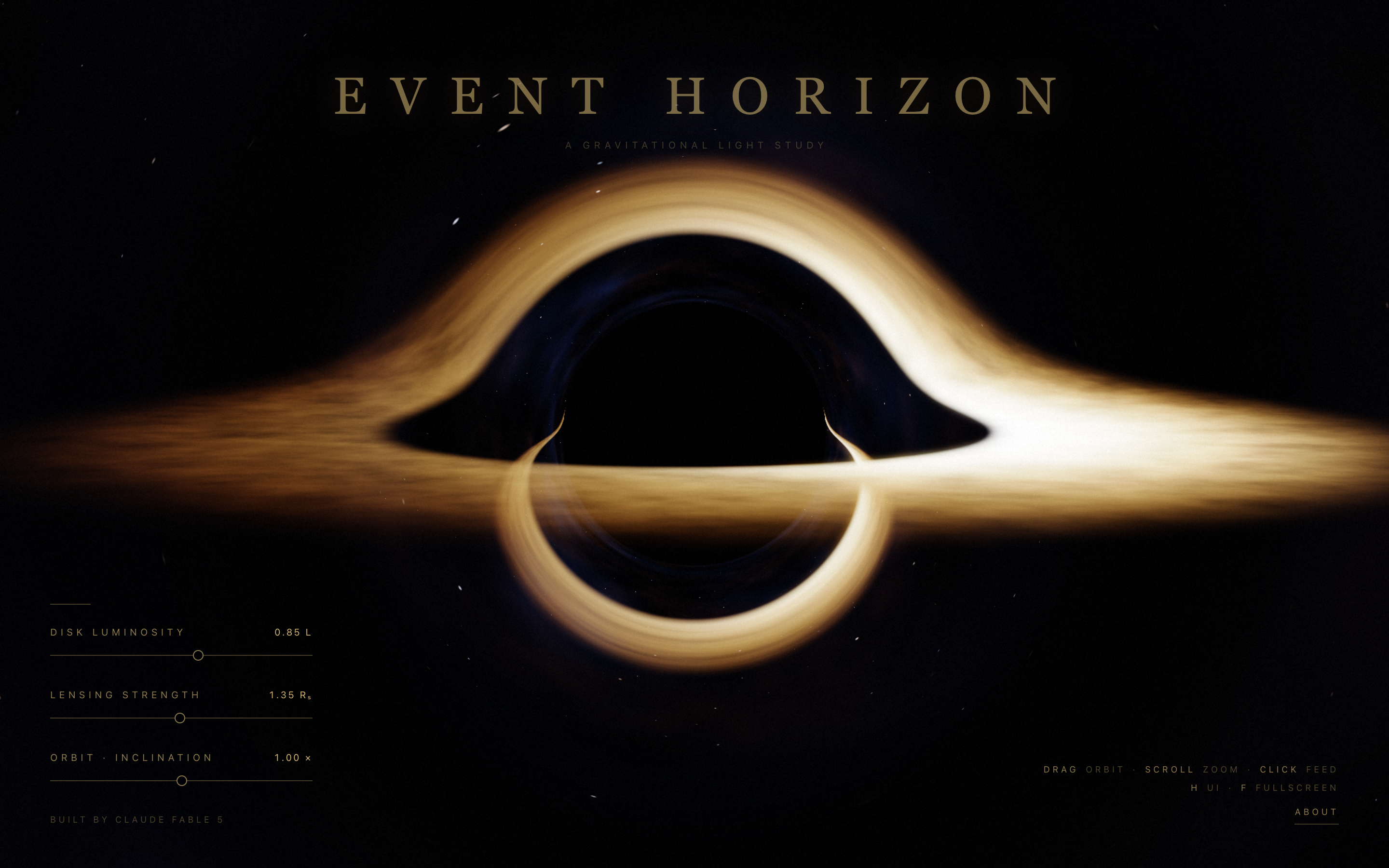
Two are worth opening yourself. Event Horizon is a gravitational-lensing black hole simulation with live sliders for disk luminosity, lensing strength, and orbital inclination — the kind of shader work that used to anchor a graphics portfolio.
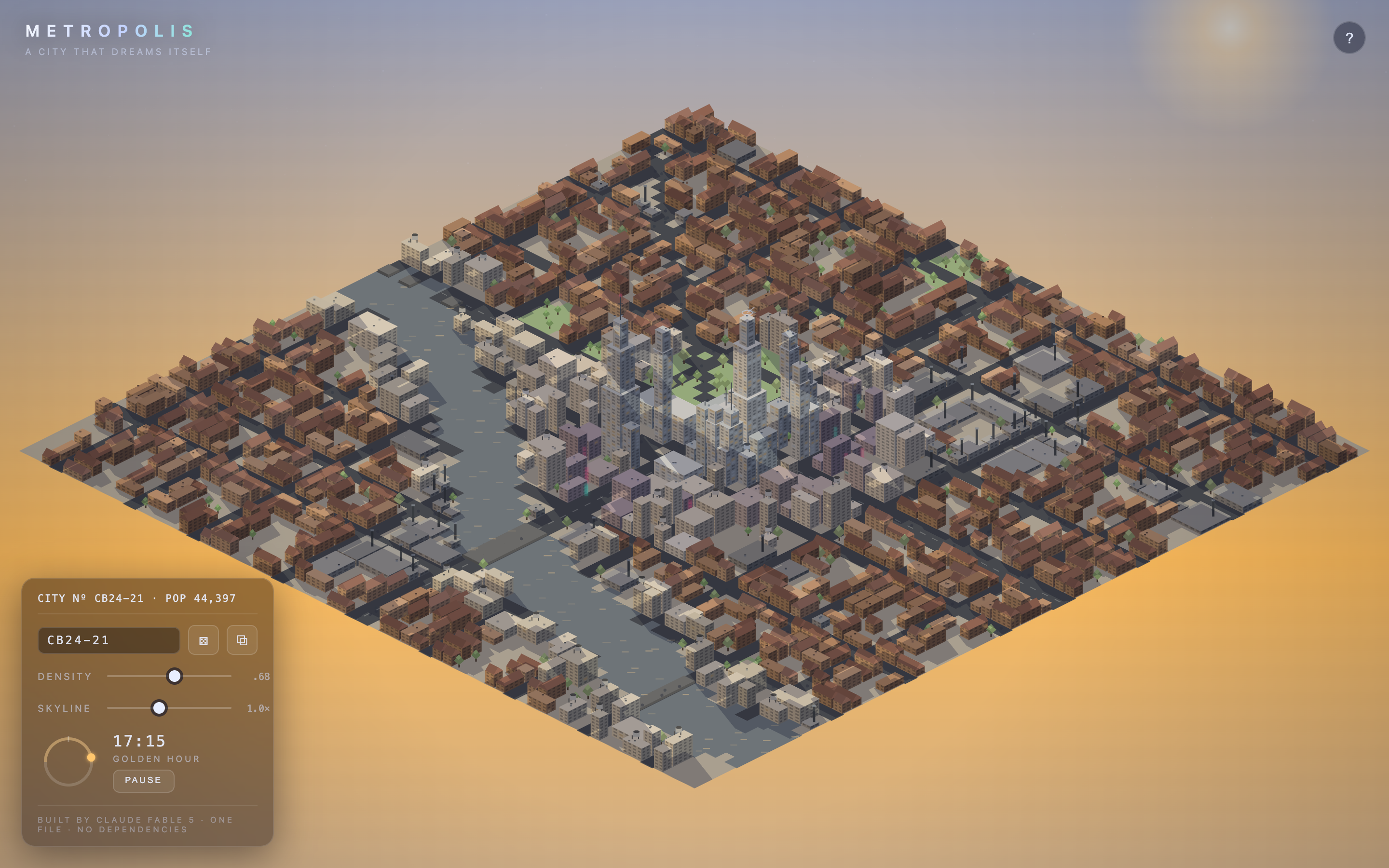
Metropolis is a procedural isometric city that regenerates its street grid, density, and skyline from a seed, with a day/night cycle running live and a population counter that updates as you drag the density slider.
The lesson here doesn't compete with Braffolk's — it complements it. Braffolk shows what one agent can sustain over a long session with the right instruments: screenshot diffing, a durable status file. FABLE-SHOWCASE shows the other axis: breadth through parallel fan-out, where the binding constraint isn't context window or session length, it's how many independent runs you're willing to pay for at once.
Depth comes from one agent with memory; breadth comes from many agents that never need to share any.
The gallery tour: 550 one-shots, prompts attached
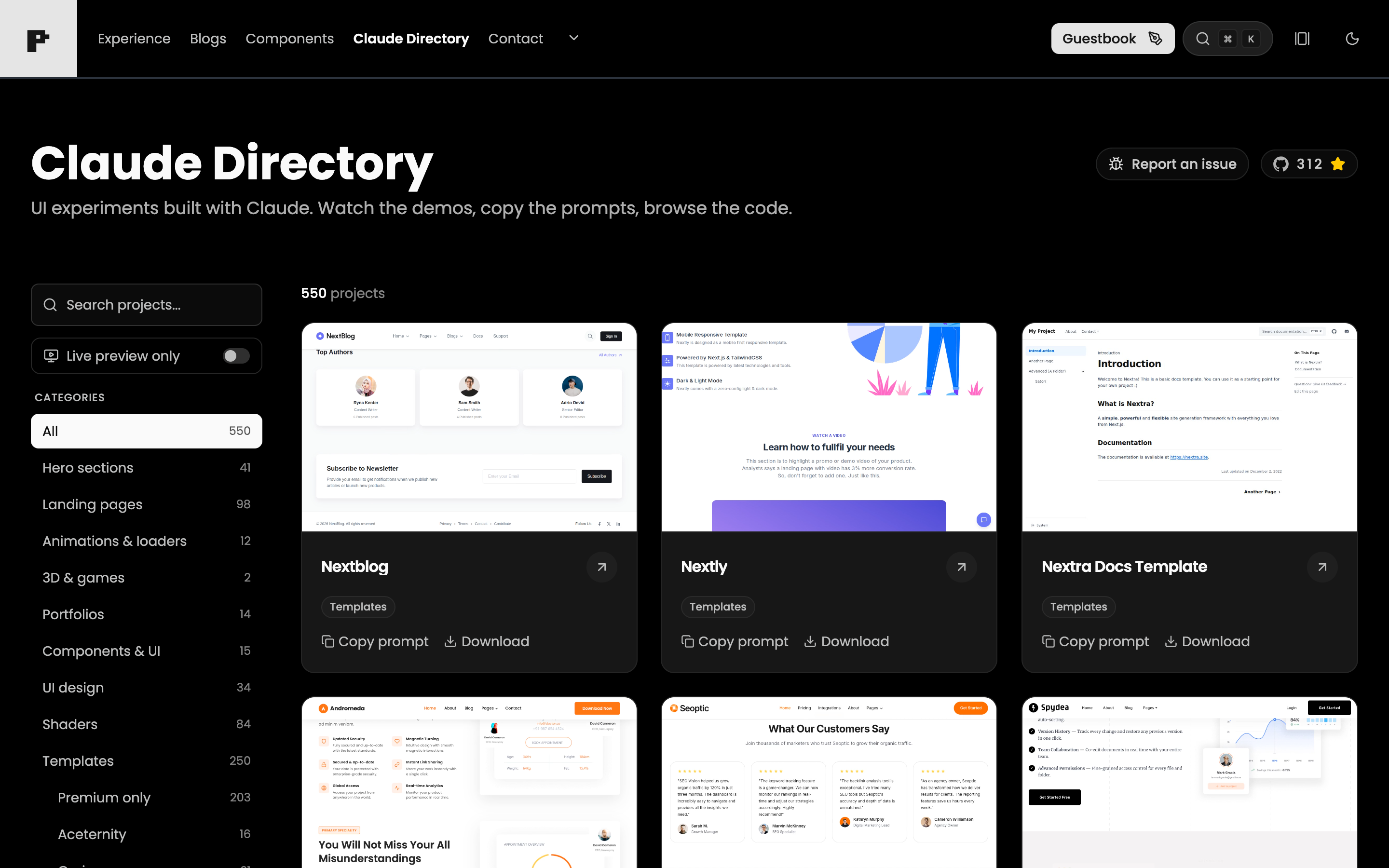
The Claude Directory is an open community gallery of UI experiments built with Claude — 550 projects across more than a dozen categories at the time of writing, from hero sections and landing pages to animations and full templates. Every entry ships three things: a live demo you can interact with, the exact prompt that produced it, and the code to download.
To be plain about provenance: the gallery is labeled "built with Claude," and its explosion coincides with the Fable 5 era, but not every individual piece is provably Fable-5-specific. What the collection demonstrates is the one-shot pattern itself — one prompt in, one finished artifact out — at a volume that makes it hard to dismiss.
That's the meta-lesson of the gallery as its own exhibit: 550 entries isn't a cherry-picked demo reel, it's a genre forming in real time.
Four pieces stand out. Each takes under a minute to open and evaluate yourself.
Animated HUD Targeting UI
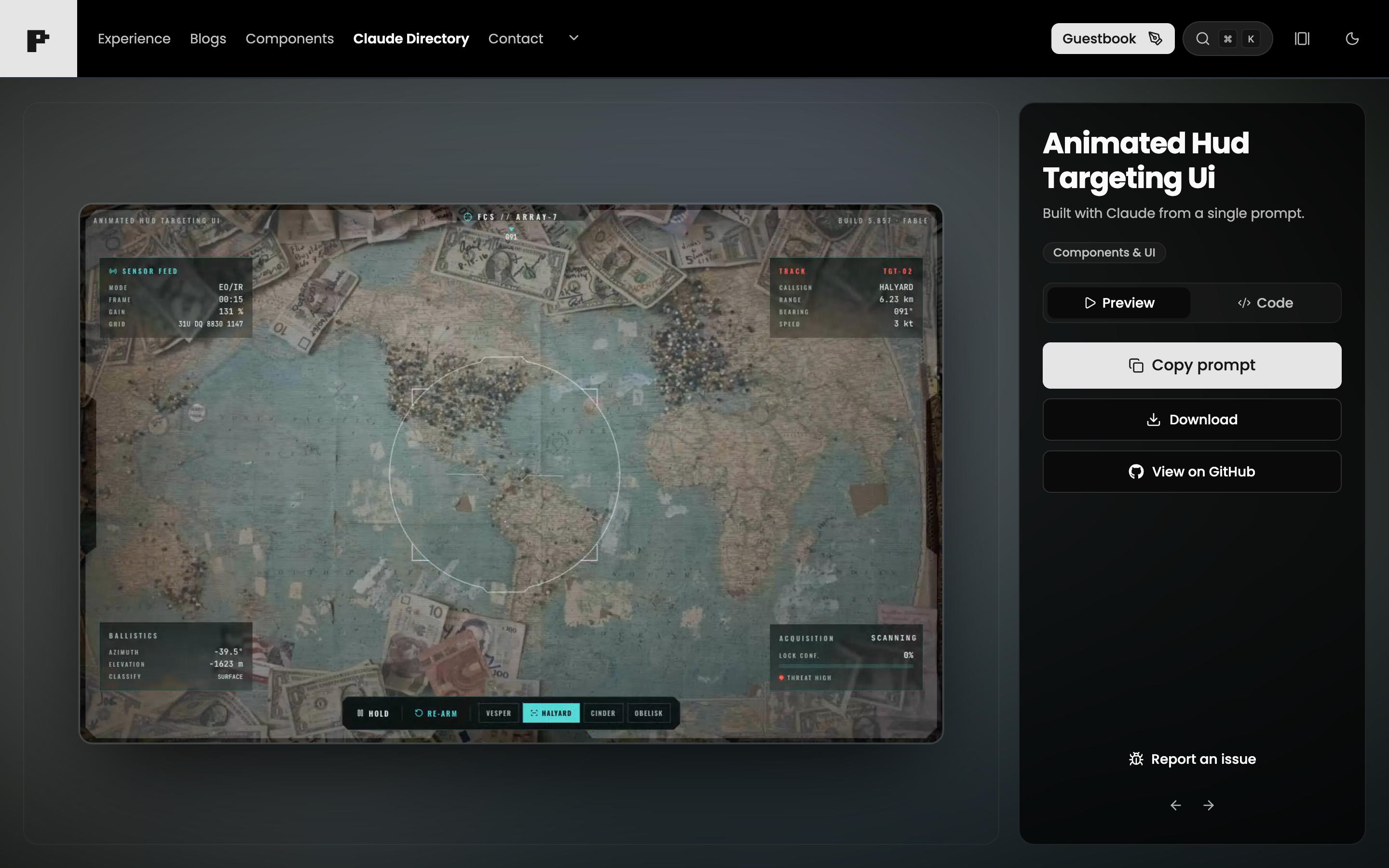
This one is a cinematic fire-control HUD overlaid on a vintage map: a live sensor feed, ballistics data, track/lock readouts, phosphor accents — the kind of interface a film production would storyboard for weeks. It came from a single prompt, filed under Components & UI, and the prompt ships with it. The takeaway: the one-shot format shines brightest on self-contained artifacts.
Everything here is visual, nothing integrates with a backend, and success is obvious at a glance. That's exactly the shape of problem where a single generation can nail it — and where you should try one-shotting before you reach for an agent loop.
Datacore Video Hero
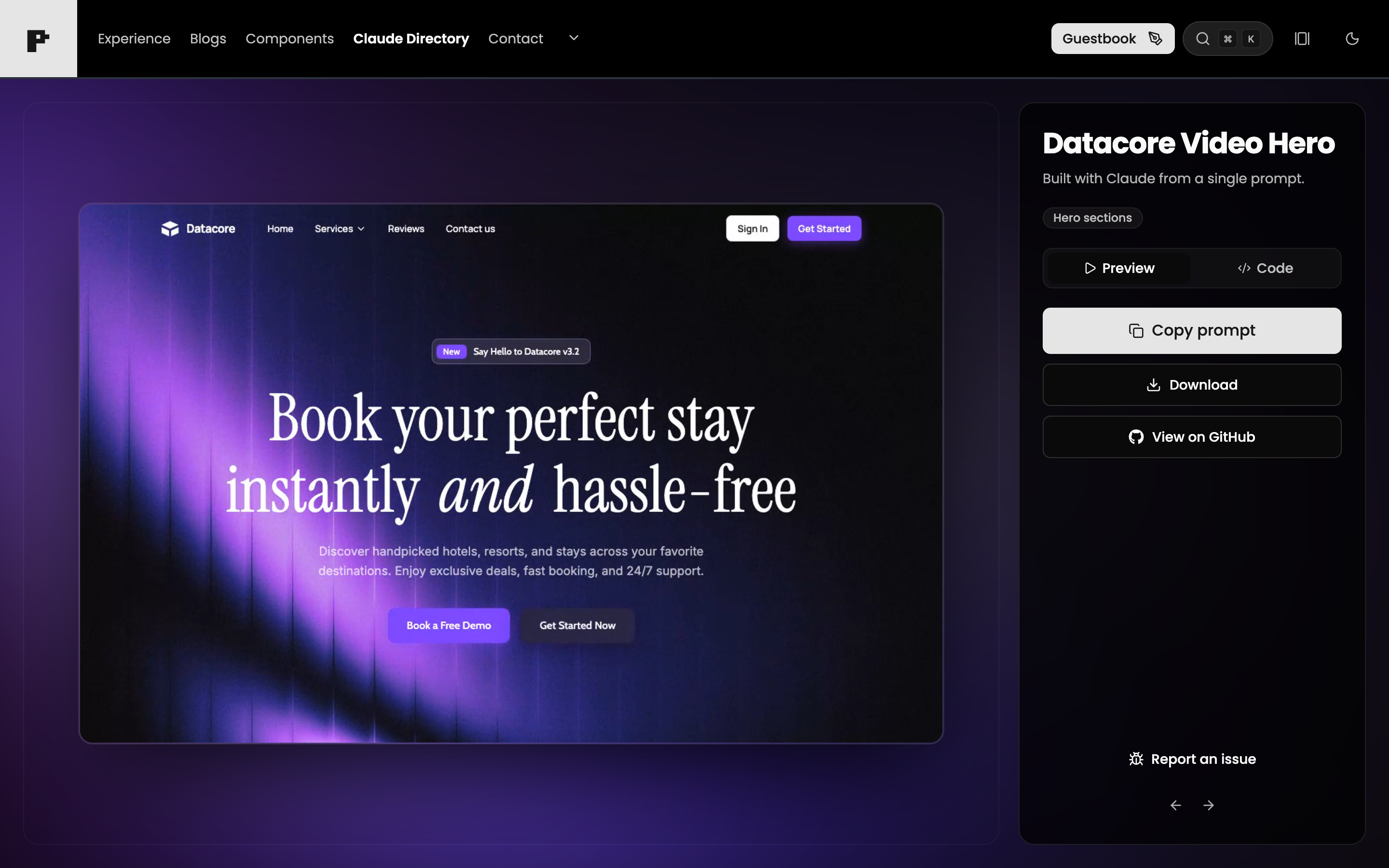
Datacore Video Hero is an elegant SaaS landing hero: purple volumetric-light background, serif display type, paired CTAs. This is commodity work that agencies bill real money for, produced in one pass. What makes it more than eye candy is that the prompt is the deliverable: change the palette words, swap the type direction, rerun, and you get your variant.
Prompts-as-artifacts means reproducibility — the same property that made open source compound. A gallery where every result carries its own recipe is a fundamentally different resource than a gallery of screenshots.
Terminal CLI Control Deck
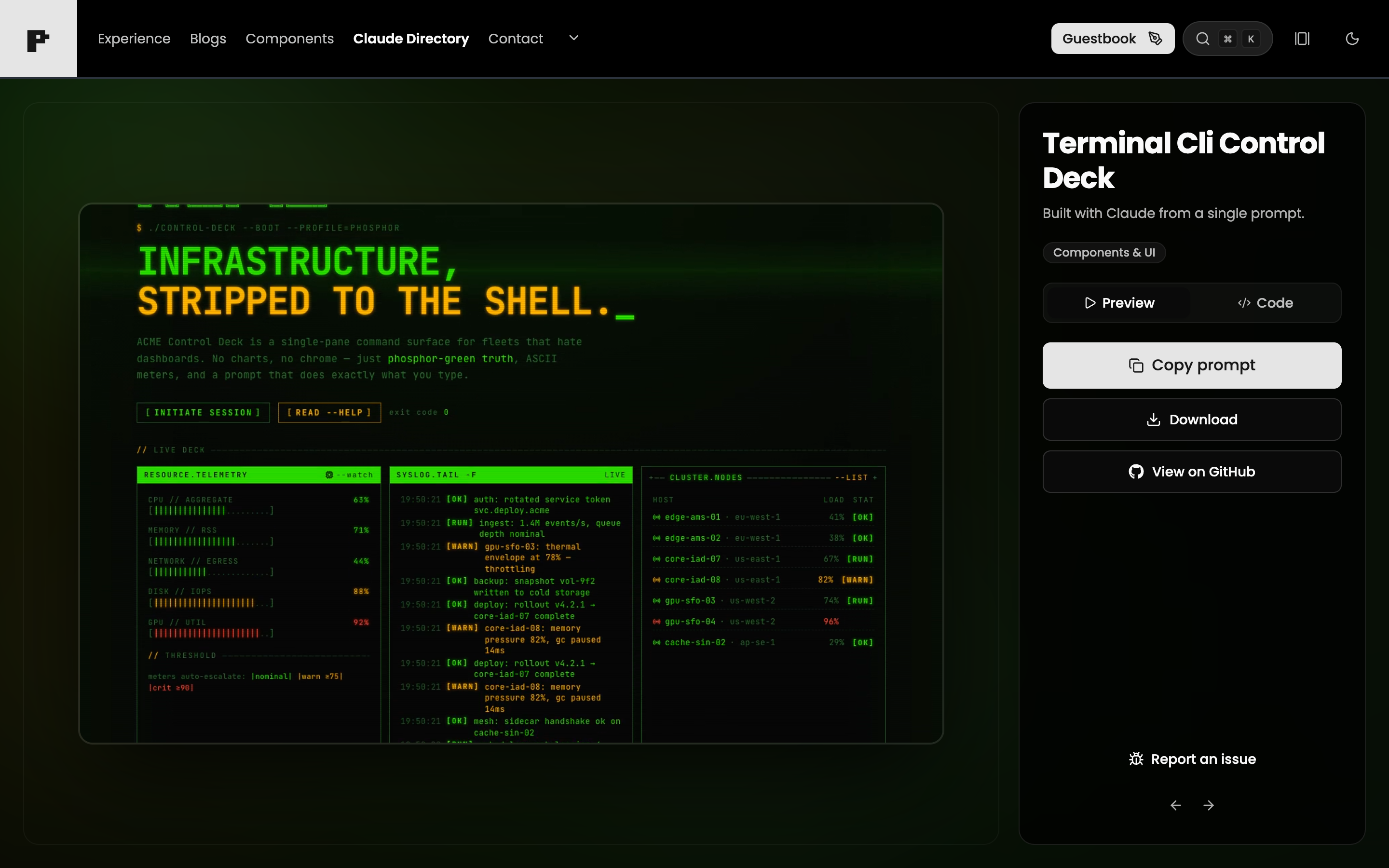
The Terminal CLI Control Deck is a phosphor-green ops dashboard with the tagline "INFRASTRUCTURE, STRIPPED TO THE SHELL": live resource meters, a syslog tail, a cluster node list — all rendered in ASCII, no chart library anywhere. One prompt. Reading that prompt next to the result is the real education: you can see exactly which phrases steered the aesthetic.
"Copy the prompt" is turning into the new "view source." A generation of front-end developers learned by reading other people's HTML; the next one may learn by reading the prompts behind pieces like this.
Gradient Bars Background
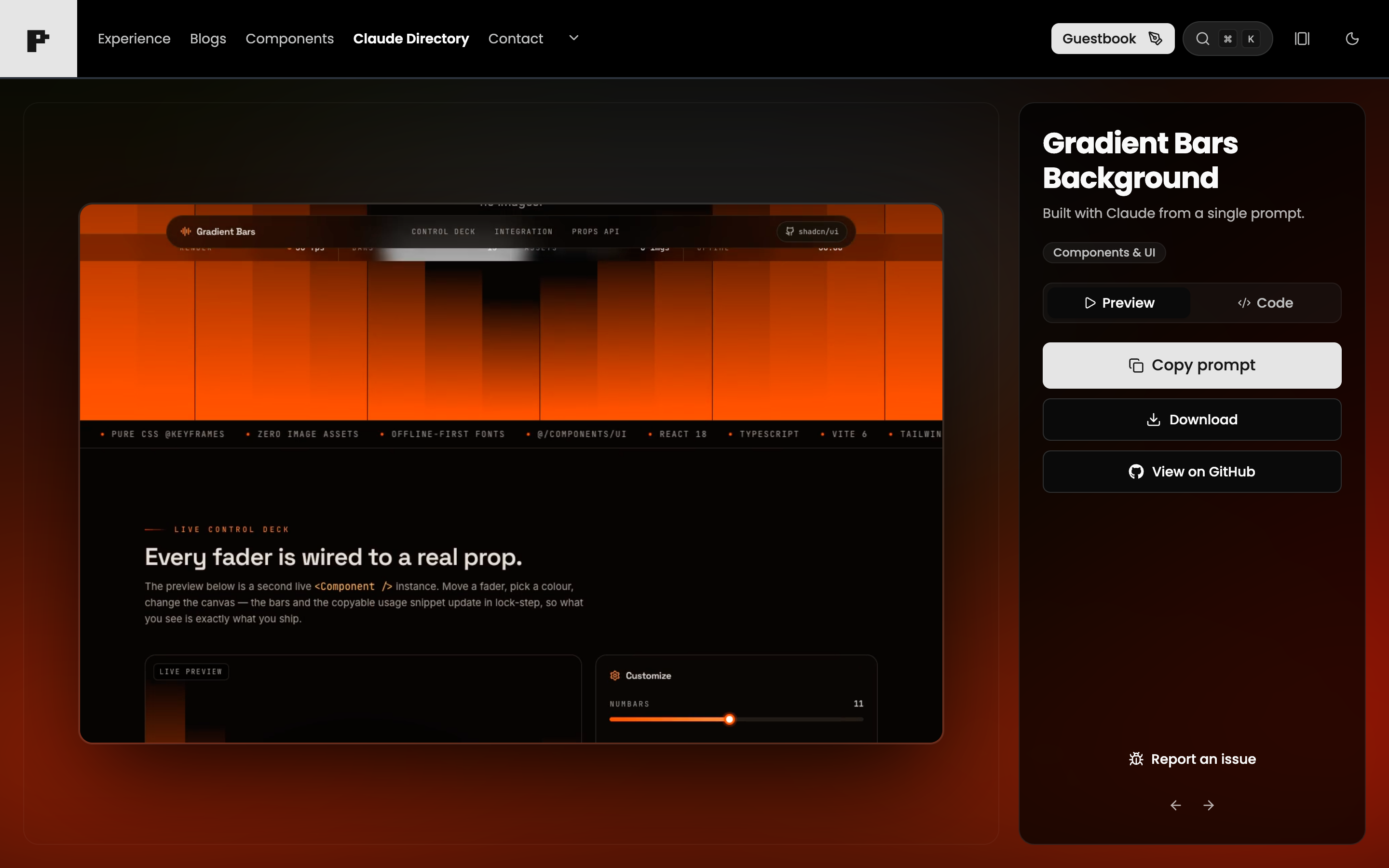
Gradient Bars Background looks like the least ambitious of the four and is quietly the most instructive. It's an animated shadcn/ui-style component — pure-CSS gradient bars — plus a live control deck where every fader is wired to a real prop. That last part is the point: the model didn't just render something pretty, it exposed an API surface.
A component with working props is something you ship; a component without them is a screenshot. One-shot output that includes the configuration layer is the difference between a demo and a dependency.
What these examples teach that one benchmark can't
Put side by side, the corpus has a consistent shape:
- One-shot excels at self-contained artifacts. Every gallery standout is a closed system: visual, single-file-ish, verifiable by looking. None of them touch auth, databases, or someone else's legacy code. Calibrate expectations accordingly.
- Ship the prompt. The Claude Directory's real innovation isn't any single piece — it's the convention that every result carries its recipe. If you publish AI-built work, publishing the prompt is what makes your claim checkable and your result forkable.
- Parallel fan-out is a different lever than a long session. FABLE-SHOWCASE didn't need a bigger context window or a longer-running agent — it needed 275 independent short runs. If a task decomposes into pieces that don't depend on each other, fanning out is often cheaper and faster than one long agent loop.
- Long-running agents need verification tooling. The Braffolk build worked because the model could screenshot, diff, and profile its own output. Autonomy without instruments is just unsupervised drift.
- Durable notes beat big context. STATUS.md as cross-session memory is a pattern worth stealing for any agent workflow, whatever the model.
- Watch the cost, because it's wildly variable. Community reports from the relaunch week put a playable Minecraft-style clone at roughly $12 in API spend, while one Medium writeup of a much smaller app came away calling it "surprisingly expensive." Token burn depends far more on how the session is run — iteration loops, verification passes, context size — than on the apparent size of the deliverable.
- Verify viral one-shot claims. Some Fable 5 showcases circulating on social media have been accused of being handcrafted or heavily assisted. The examples above were chosen because you can open them, run them, and in the Braffolk case read the commit history. Extend the same skepticism to the next thread that crosses your feed.
Caveats before you extrapolate
The honest frame for all of this: the gallery pieces are "built with Claude from a single prompt" according to their authors, not independently audited, and the directory predates Fable 5 even if its growth doesn't.
The Braffolk world and FABLE-SHOWCASE are the strongest evidence in the set — public repos, public tooling or working notes — but Braffolk's 99% figure and FABLE-SHOWCASE's ~275-run count are still each author's own accounting.
Three weeks is a demo window, not a track record; nobody has yet maintained a Fable-5-built codebase through six months of changing requirements, which is where AI-written code historically gets expensive. And the export-control gap means the community is effectively two weeks into round two.
Treat everything here as a strong early signal about where this model is unusually good — self-contained visual artifacts and instrumented autonomous builds — rather than proof it replaces your judgment on the software that actually pays your bills.
If you want to keep pulling the thread, the awesome-claude-fable-5 list is the running community index of use cases, and the Hacker News launch thread has the least filtered practitioner reactions you'll find.
References
- Braffolk/fable5-world-demo — procedural 3D open world built ~99% by Claude Fable 5 (GitHub)
- Claude Directory — 550 UI experiments built with Claude, each with prompt, code, and live demo
- elder-plinius/FABLE-SHOWCASE — 57 self-contained demos built by ~275 parallel Claude Fable 5 subagent runs from one prompt (GitHub)
- Animated HUD Targeting UI — Claude Directory
- Datacore Video Hero — Claude Directory
- Terminal CLI Control Deck — Claude Directory
- Gradient Bars Background — Claude Directory
- Claude Fable 5 Is Back — I Just Built My First Simple App. It Was Surprisingly Expensive (Medium)
- Claude Fable 5 one-shot showcases face authenticity questions (36Kr)
- Anil-matcha/awesome-claude-fable-5 — curated list of Fable 5 use cases (GitHub)
- Hacker News discussion: Claude Fable 5